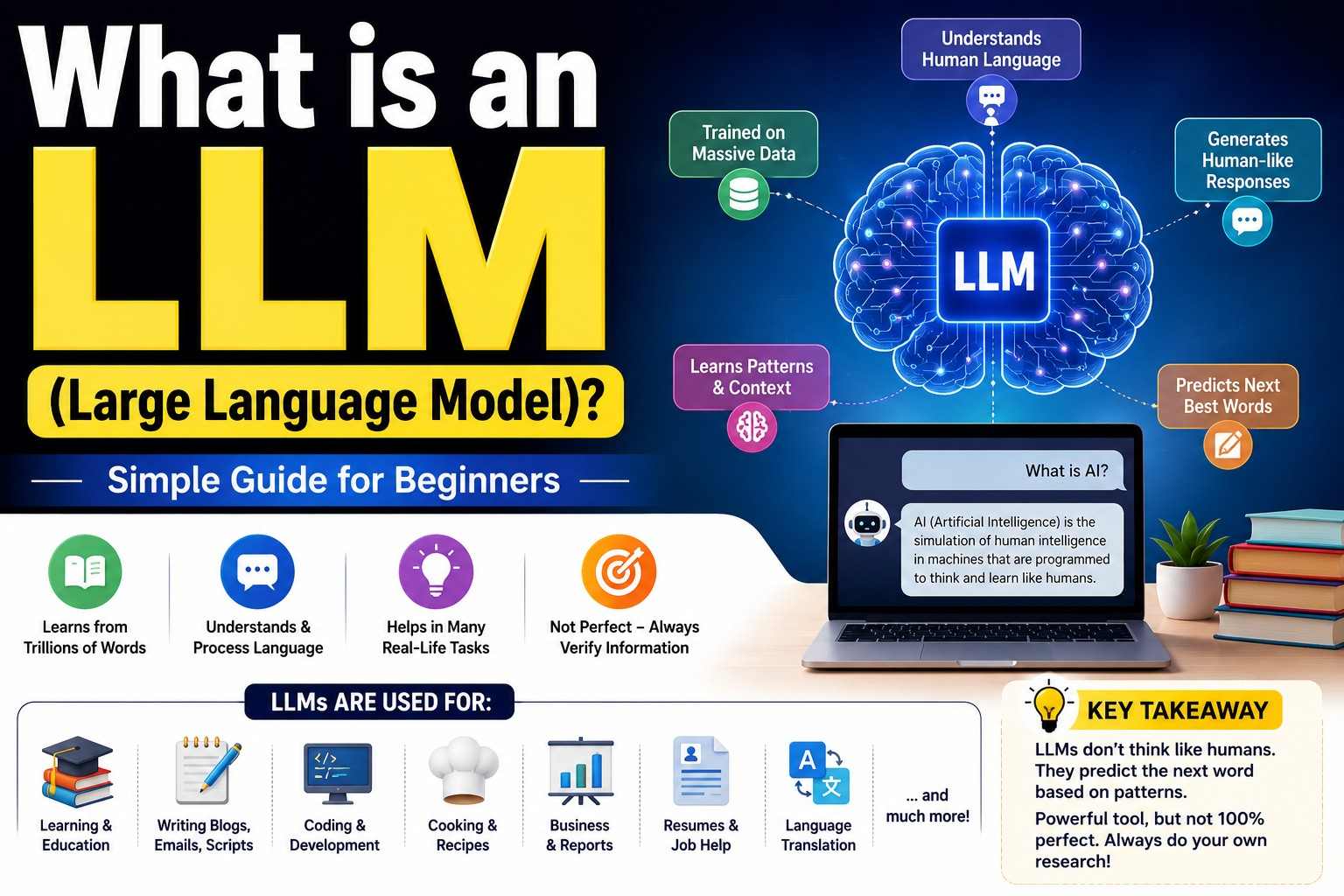
Whatever question you type into ChatGPT, Gemini or Claude, an LLM is working behind it. The name sounds big, but it is the same thing that is already sitting open on your phone. In the previous post we understood the basics of AI. This post explains LLM, the best-known form of that AI, from the very beginning.
Different AI models and where LLM fits
AI is not one single thing. Many different models come under it. You may have heard that someone writes text and a video or photo gets made from it. Models called diffusion models often do this kind of work. They create a picture or video based on text.
On the other side are the tools you can talk to, ask questions, and get answers from in text. ChatGPT and Google Gemini are of this kind, and a language model sits behind them.
There are many more kinds of models, but going into them here would only add confusion. This post talks only about the one type you hear about the most: the Large Language Model, called LLM for short.
What an LLM is
The full form of LLM is Large Language Model. It runs on deep learning, and it is trained on text at a very large scale, meaning books, website text, articles and samples of conversation. Deep learning is a method of machine learning in which a computer learns patterns through a system with many layers.
One important thing to make clear. ChatGPT, Gemini and Claude are the names of chatbots, meaning the apps in which you chat. The brain that works inside those apps is the LLM. In everyday talk people take both as one thing, and at the beginning there is no harm in that.
“Large” means very big: very big data and a very big model. “Language model” means a model that understands language and replies in language.
Why so much focus on language
When we look at social media, what is there? Language. A student does homework, and there is language in it. A businessperson is writing an email, someone is sending a job application, contracts are being signed, tutorials are being made. What is common in all of these? Language.
So an AI that understands language well can make a lot of human work lighter. Most of our work is connected in some form to writing, reading or explaining. In my view, this is the biggest reason LLMs have spread so much: they caught hold of something that applies in every profession.
The librarian example
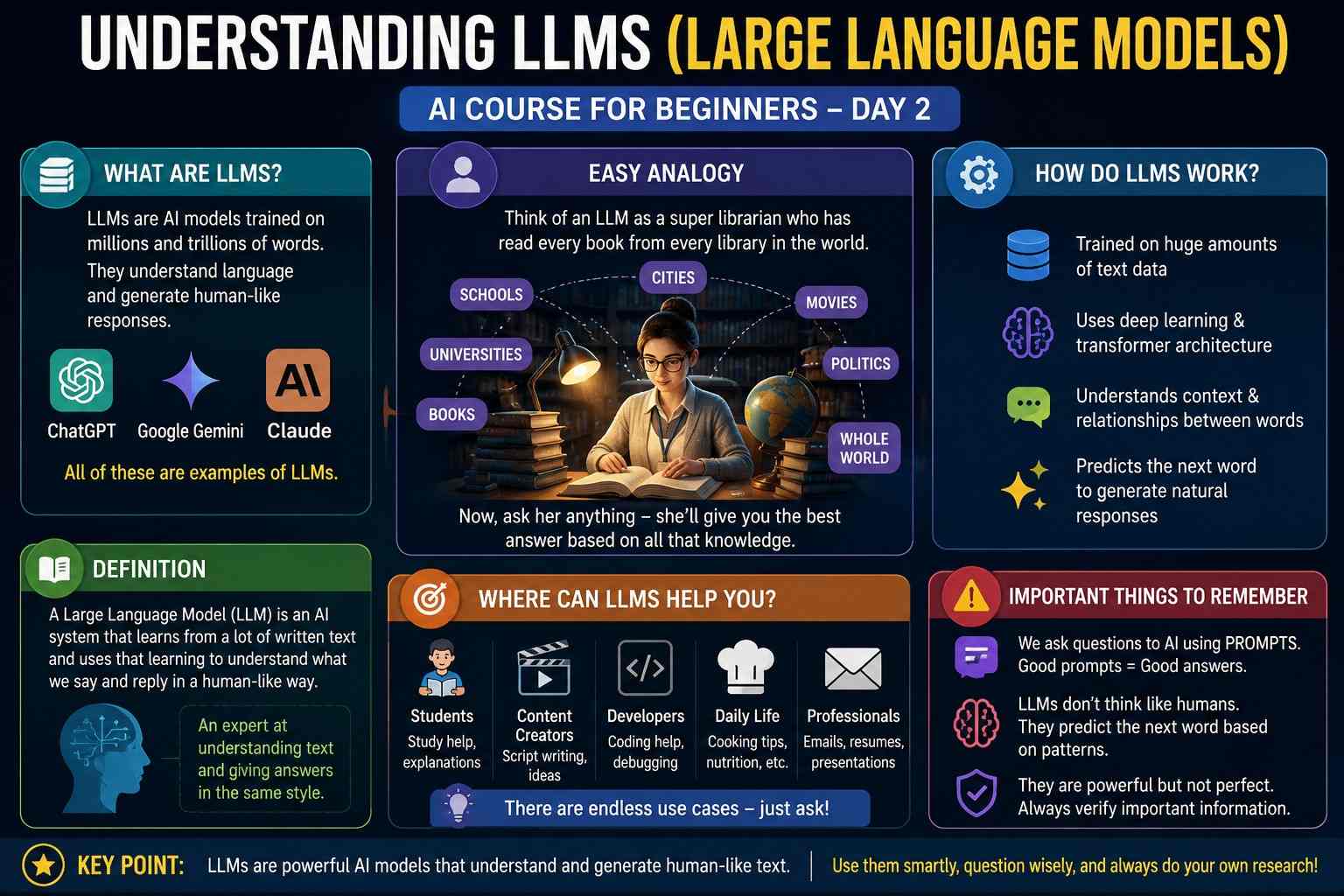
Imagine you went to a school that has a very big library, with books on different subjects kept in it. A librarian sits there who has read every book. She remembers what is written in which book. Ask her anything and she answers right away.
One thing to notice here. She is not creating new information. She answers based on what she has read and the patterns she has picked up inside herself. The basic way a language model works is the same.
Now imagine that librarian gets a chance to read far more. At first there was only one school’s library. Then she got the books of the other schools in that city, the universities, and people’s homes. Then different cities of India, different states, movies and politics. In the end she gets information from the whole world.
Now you can ask her not only library questions but anything, from history, movies and politics to food and drink advice, because she is trained on a very large amount of data. A Large Language Model is like this. It has a huge amount of data, and it builds the answer to a question from the patterns learned from that data.
Remember one difference. A real librarian remembers books, but inside an LLM the books are not kept one by one. What it has is learned in the form of patterns. So this example is good for understanding, but do not take it as a fully accurate picture.
The definition of LLM and what a prompt is
A simple definition: an LLM is an AI system that learns from a large amount of written text, understands what you say, and replies in human-like language based on that learning. It is good at understanding text, and also good at answering in the same style in which the question was asked.
Now a word that will keep coming up: prompt. Whatever question or instruction you type to AI is called a prompt. To a large extent, how the answer turns out depends on the prompt. A good prompt brings a good answer, and a vague prompt brings a vague answer.
Suppose you write:
Tell me something.
The answer will be all over the place. Now write the same request like this:
I am a 10th class student. Explain photosynthesis in 5 easy lines.
This time the answer will be directly useful to you. Ways of writing prompts will come in a separate post.
How an LLM works
Inside an LLM there is a design called the Transformer architecture. Its job is to let the model, instead of looking at each word separately, also understand which word in a sentence is connected to which other word. This is how it catches context.
A small example. In “I sat near the bank and withdrew money” and “I sat on the river bank and caught fish,” the word “bank” is the same, but the meaning is different. A model that understands context looks at the surrounding words and catches the right meaning. This is why an LLM’s answer often feels very natural.
After this, the same thing happens that was explained in the previous post. The model looks at all the words you wrote and estimates the next word, then the one after that. In this way small pieces join together to make the whole answer. For me, understanding that the answer is built in pieces and not in one go is the clearest way to see an LLM as a “very fast estimating system” instead of a “brain.”
Where an LLM can help you
In terms of work, an LLM helps in many places:
- If a topic feels hard, a student can get it explained in different ways
- Someone who makes videos gets a first draft of a script
- Someone learning coding or a new language gets question-and-answer support
Beyond that, writing better emails, building the outline of a presentation and preparing a first draft of a resume are also common uses of an LLM. If you want to learn cooking, you can take tips too. The rule is simple: for work connected to language, ask an LLM first and see.
But here is a warning. The draft an LLM gives is not your final work, it is your starting work. Use it only after reading it, checking it and changing it to suit you. This post is only for understanding, and steps for any particular tool are not part of it.
LLM limitations and mistakes
One thing should be kept completely clear. An LLM cannot think like a human. It has become so good at catching the next word that it seems as if it is thinking, but in reality it makes estimates based on the information it has.
So an LLM can give wrong information, and it can give it with full confidence. It can write the name of a book, a person’s statement or a date as if it were completely real. This mistake is called hallucination. On money, health, law or any important matter, it is necessary to check the answer against a trustworthy source.
Second, an LLM’s knowledge goes only up to the time until which it was trained. Whether it knows fresh news depends on whether that tool is connected to web search. This has to be checked on each tool’s official page.
Third, if you ask a vague question you will get a vague answer. And fourth, an LLM is very fast and never gets tired, so getting carried away by praise and depending on it alone is the biggest mistake. In my view, it is right to treat an LLM like a very fast but new assistant: it finishes work quickly, but checking it is your job.
Privacy and safety
Before typing anything into an LLM, remember that it is not a private diary. Do not put your Aadhaar number, bank details, OTP, password or anyone else’s personal information into a chatbot.
Do not enter confidential office or school information without permission either. Every tool has its own privacy policy, and how long your conversation is kept, or whether it is used for later improvements, can differ. Whichever tool you use, do look at its privacy setting once.
Who this is for and who it is not for
This post is for students who use ChatGPT or Gemini every day but don’t know what is inside, because no technical word has come here without being explained. It is also for working people who hear the word “LLM” at the office but cannot understand its meaning. And for people who keep seeing this word on social media and want to know, in plain language, only what it is.
This post is not for people who want to build an LLM themselves or learn the math of the Transformer. They need separate, deeper courses in machine learning. It is also not for people looking for a comparison of the price or features of different LLMs, because that information keeps changing and has not been given here.
Disclaimer
This post is only for a beginner-level understanding. In matters of health, money or law, do not rely on an LLM’s answer alone, and do take advice from a knowledgeable person.
How to Make a Full AI Song Using ChatGPT and Suno AI
How to Turn Any Text Into Realistic Voice Using Free AI Tools