
Machine Learning & Algorithms Explained Simply
Do You Remember the Last Lesson?
So, friend, we've covered a lot of ground in the previous parts of this series — what AI actually is, how it works, and that term "LLM" you probably hear thrown around everywhere these days. If you haven't gone through those earlier parts yet, here's an honest suggestion: read them first. Trust me, today's topic will make a lot more sense once those basics are clear. So let's begin Part 3 — today we're talking about Machine Learning and Algorithms, explained in the simplest way possible.
What Does Machine Learning Actually Mean?
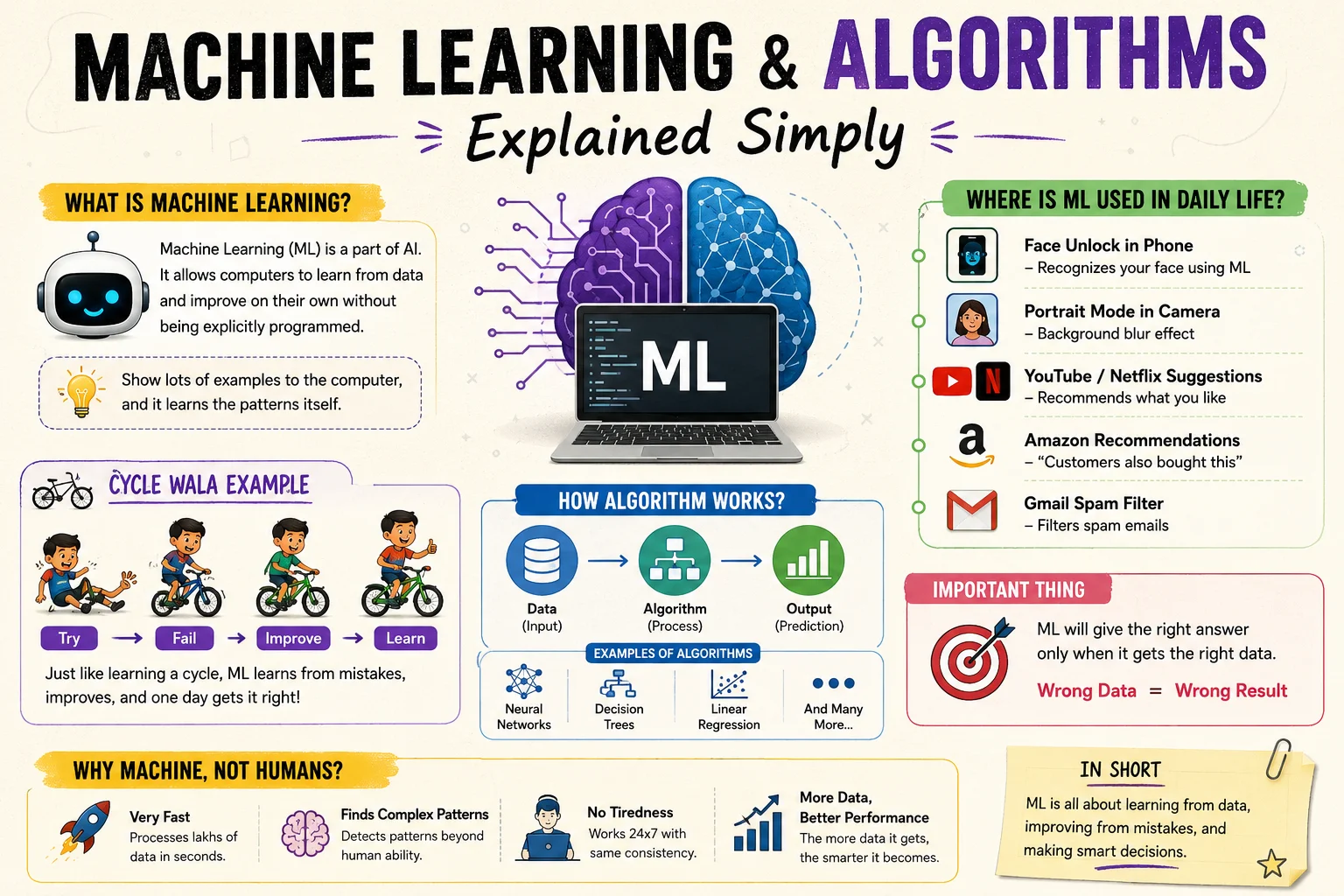
We already know the definition of AI — a system that reads a huge amount of data and finds patterns in it. But here's the real question: how does it "read"? How does the training actually happen? This entire process is called Machine Learning, or ML for short. In one line — we show the computer a lot of examples, and it learns to figure things out on its own from those examples. No manual, no rulebook involved.
Let's Understand It With an Example
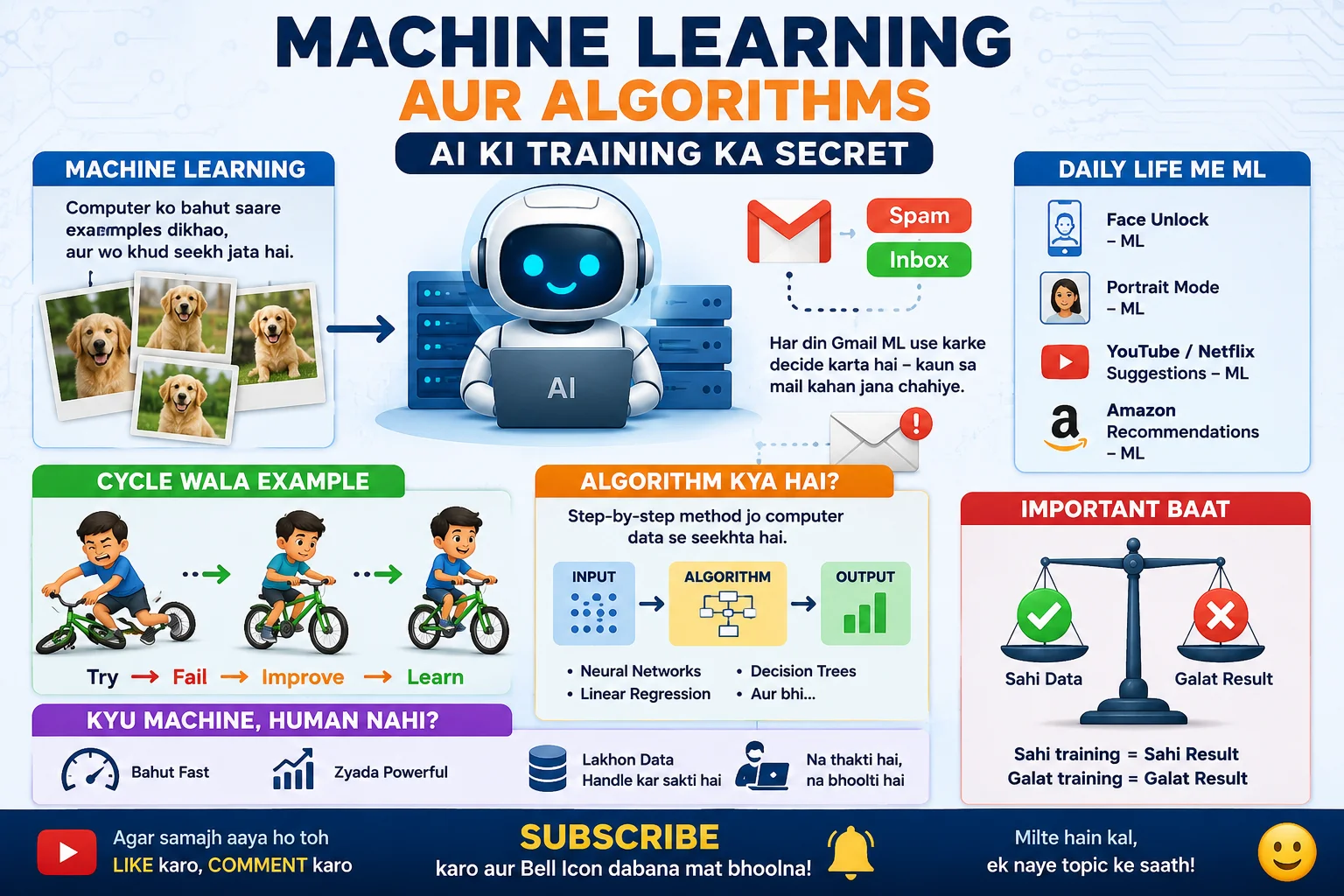
Imagine we showed a computer a thousand photos of dogs. The interesting part is that it learns what a dog looks like entirely on its own — we never explicitly tell it, "Hey, dogs have two ears and a tail." It figures this out purely by observation. The same thing happens in your Gmail every single day — some emails land straight in your inbox, others automatically go to spam. That's ML quietly working in the background, making that decision.
The Cycle Example — Everyone Can Relate to This
Remember learning to ride a bicycle as a kid? You definitely didn't learn it by reading a manual. You tried, fell, tried again, fell again — and one day, balance just clicked. Machine Learning works exactly the same way: feed it data, let it make mistakes, and gradually improve it over time. This cycle repeats until the system learns to perform correctly. The core idea isn't handing it direct rules — it's letting it learn from its own mistakes.
Where Is ML Hiding in Your Daily Life?
Think about it — the face unlock on your phone? That's ML. Portrait mode with that nice background blur? ML is working there too. The recommendations you see on Netflix or YouTube, or that "customers also bought this" line on Amazon — all of it runs on Machine Learning behind the scenes.
You've Probably Heard the Word "Algorithm" Too
Alongside ML, there's another term you've likely come across — Algorithm. Simply put, an algorithm is just a step-by-step method that a computer uses to learn from data. Neural Networks, Decision Trees, Linear Regression — these are all types of algorithms. For now, this basic understanding is enough; we won't dive deeper into it.
Why Machines, and Not Humans?
You might be wondering — why not just do this ourselves? The answer is simple: machines are fast and powerful enough to spot patterns far beyond human capability. Whether it's detecting fraud in massive transactions or reviewing thousands of applications — a person might manage 50-100 in a day, while a machine can process lakhs. And the more data it receives, the better it gets over time. It doesn't get tired, doesn't forget, and never asks for a day off.
One Important Thing to Remember
Keep this in mind — AI will only give the right answer when it's trained on the right data. If the training itself is flawed, the results will be flawed too. It really is that simple.
Wrapping Up
So today, we covered the basics of Machine Learning and Algorithms. In the next part of this series, we'll continue building on these concepts step by step.