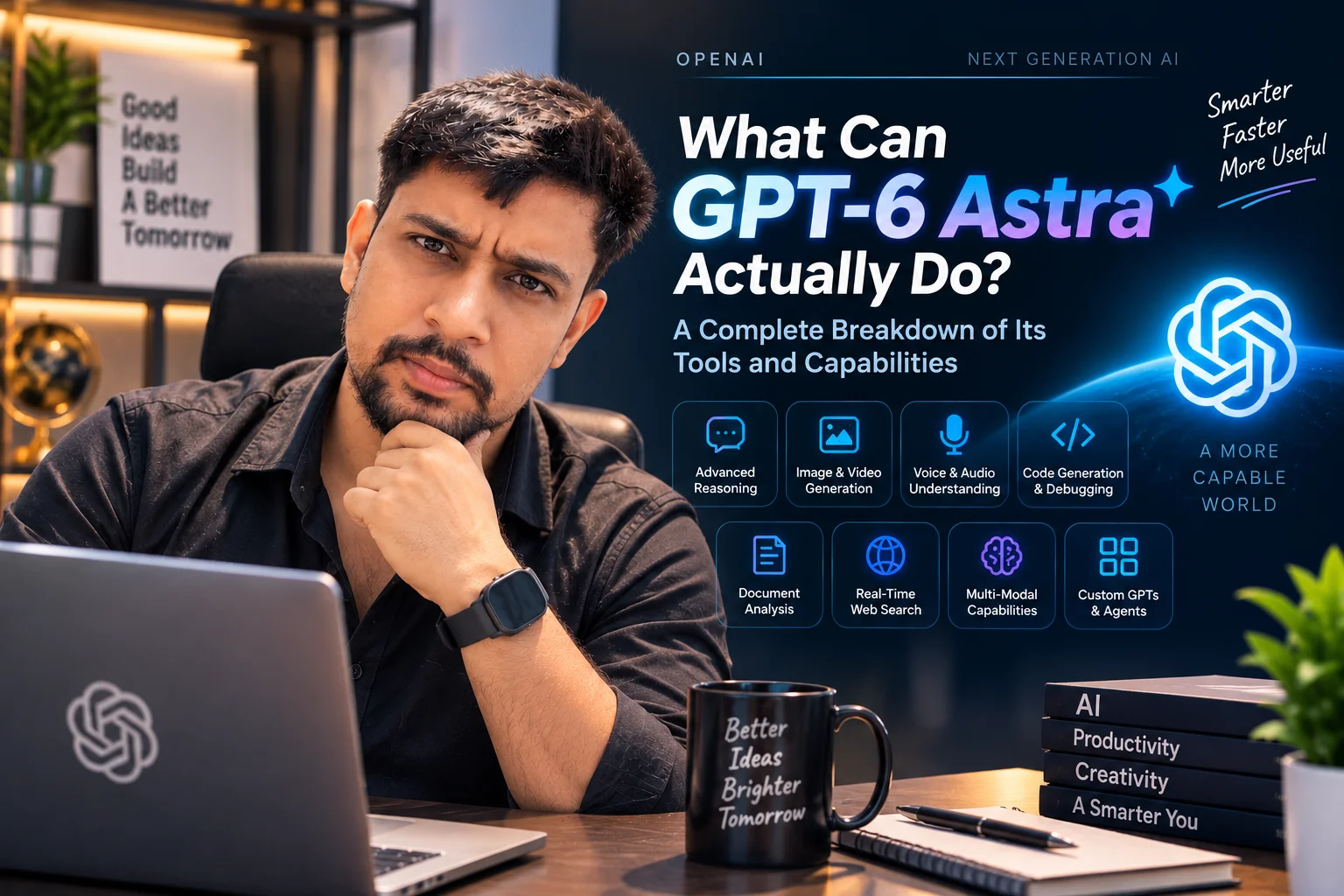
What Can GPT-6 Astra Actually Do? A Complete Breakdown of Its Tools and Capabilities
Ever since GPT-6 Astra was released, I have noticed the same question popping up everywhere, in comment sections, in group chats, even from people who do not usually follow AI news closely. Everyone wants to know one simple thing: what does this model actually do that is so different from what we already had? It is a fair question, because "state of the art" and "most intelligent model" sound nice on a press release, but they do not really tell you anything useful if you are just trying to figure out whether it can help you with your own work.
So I decided to break this down properly, capability by capability, in plain language, based on how these tools actually behave rather than repeating marketing lines. If you have been searching for what GPT-6 Astra can do and are tired of vague answers, this should give you a clearer picture.
Computer Use: Letting the Model Actually Operate a Computer
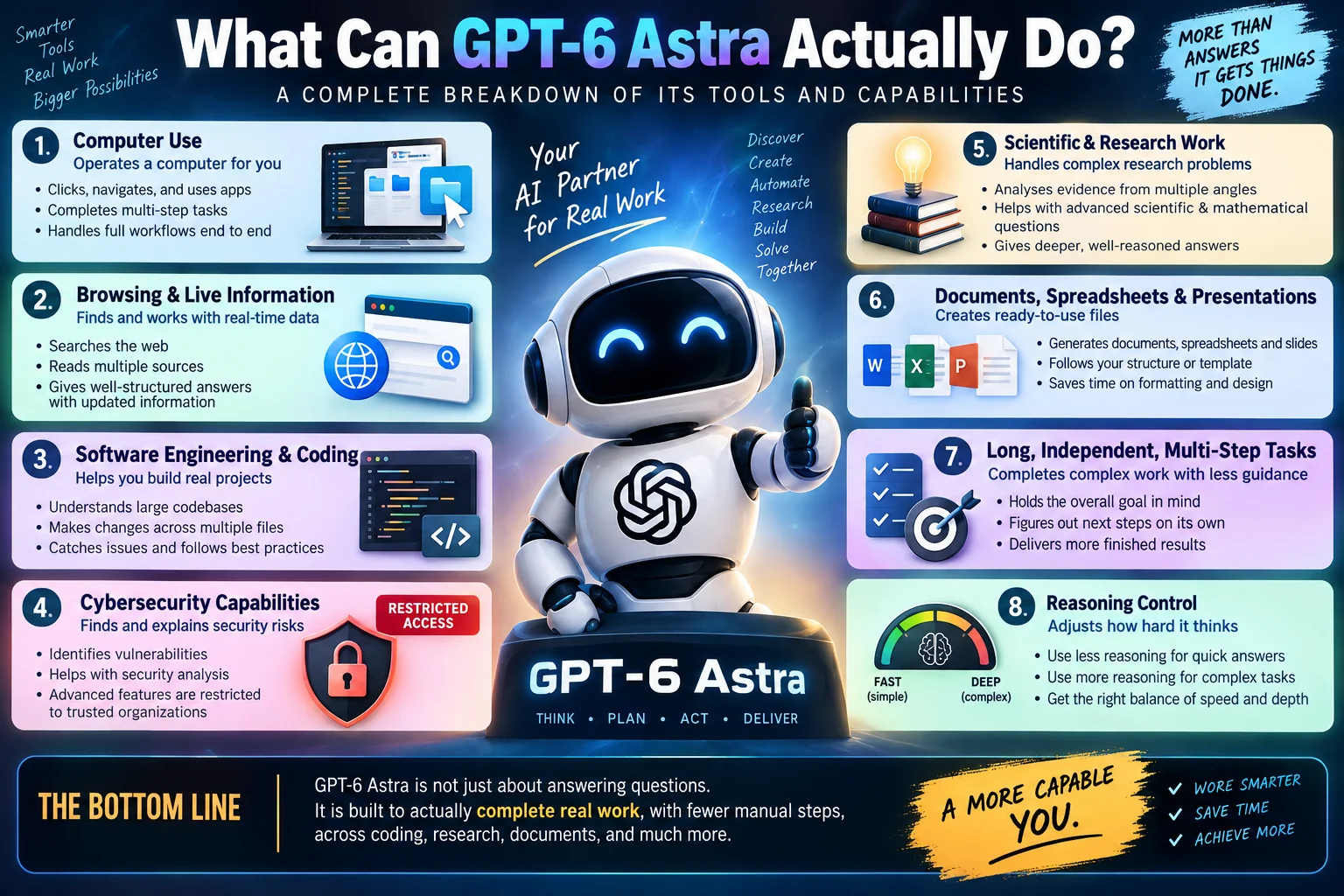
This is probably the single biggest talking point around Astra, and honestly, it is the one that surprised me the most. Computer use basically means the model is not limited to just typing back answers in a chat box. It can actually interact with a computer environment, click through interfaces, navigate between applications, and carry out a sequence of actions on its own to complete a task, rather than just telling you the steps and leaving you to do them yourself.
Think about a task like gathering information from three different websites, organising it into a spreadsheet, and then writing a short summary based on that data. Earlier, you would be doing most of that manual back and forth yourself, using the AI only for the thinking part. With strong computer use, a big chunk of that entire workflow can be handled directly, with the model moving between steps on its own instead of waiting for you to copy and paste things back and forth.
Browsing and Working With Live Information
Closely related to computer use is browsing, which lets Astra go out and look things up rather than relying only on what it already knows from training. This matters a lot for anything time sensitive, current events, recent product launches, or anything where the answer genuinely depends on what is happening right now rather than something fixed and unchanging.
What I found genuinely useful here is that it does not just fetch one page and repeat it back to you. It tends to pull information from a few different places and put it together in a way that actually answers your question, rather than just dumping a pile of search results and leaving you to sort through them yourself.
Software Engineering and Coding
I already touched on this in my earlier post about my personal experience, but it deserves its own explanation here because it is genuinely one of the strongest areas. Astra has been built with a heavy focus on real software engineering work, not just writing small isolated code snippets. That includes understanding an existing codebase, making changes across multiple files while keeping everything consistent, catching edge cases before they turn into bugs, and following a project's existing style and structure instead of just producing generic code that technically works but does not fit in.
For anyone who writes code regularly, this is the difference between a tool that helps you type faster and a tool that actually understands what you are building and why. It is not perfect, and I would still recommend reviewing anything important before shipping it, but the quality of reasoning behind the code has clearly improved.
Cybersecurity Capabilities
This is an area where Astra is genuinely more advanced, but also more restricted, and for good reason. The model has strong capabilities around identifying vulnerabilities, understanding security flaws, and working through security related problems at a level that previous models simply were not built for. Because this kind of capability can obviously be misused, OpenAI has kept the more advanced parts of this locked behind a trusted access program available only to vetted organisations, rather than opening it up to everyone by default.
For a regular user, this mostly means you will not be able to push it into doing certain advanced security tasks, and that is intentional rather than a limitation you need to work around. It is one of those areas where being cautious is clearly the right call.
Scientific and Research Work
If your work involves anything research heavy, this is one of the more exciting parts of Astra. It has been designed to handle harder, multi layered research problems, going beyond just summarising a topic and actually working through evidence, considering multiple angles, and building toward a genuinely useful conclusion rather than a surface level overview.
OpenAI has talked about it contributing to progress on some genuinely difficult scientific and mathematical problems, and while most of us are not working on cutting edge research papers, this same underlying strength shows up in smaller ways too, like when you ask it to dig into a complicated topic and it actually structures its answer like someone who understands the subject deeply, rather than someone who has just skimmed a few articles.
Creating Documents, Spreadsheets and Presentations
This is one of those features that sounds simple on paper but genuinely saves a lot of time in practice. Astra can create actual documents, spreadsheets, and presentations based on your instructions or an existing template, rather than just giving you raw text that you then have to format yourself. If you give it a rough outline for a report, it can turn that into something that actually looks like a finished document, following whatever structure or style you specify.
This is especially useful for anyone doing regular office work, client reports, internal presentations, or data heavy spreadsheets, where the formatting and structure matter just as much as the content itself.
Handling Long, Independent, Multi Step Tasks
One of the more subtle but important capabilities is how well Astra can take a task from a rough starting instruction all the way to a finished result, without needing constant hand holding along the way. Earlier models, including Sol, were quite good at individual steps, but often needed you to guide them through each stage of a longer task.
Astra is noticeably better at holding onto the overall goal across a longer stretch of work, figuring out what needs to happen next on its own, and coming back with something closer to a finished output rather than a partial answer that still needs several more rounds of instructions from you.
Reasoning Control: Adjusting How Hard It Thinks
This is a smaller feature, but a genuinely practical one. Astra allows you to adjust how much reasoning effort it puts into a task, depending on how complex that task actually is. For something simple, you do not need the model spending extra time thinking deeply, and you can keep things fast. For something genuinely complicated, you can let it take more time and reasoning depth to work through the problem properly.
This kind of control is useful because it means you are not stuck with a one size fits all approach, where simple questions take unnecessarily long or complex questions get rushed answers.
So, What Does All This Actually Mean for You?
If I had to sum up everything above in one line, it would be this. GPT-6 Astra is built less around answering isolated questions and more around actually completing real work, coding projects, research tasks, document creation, and multi step processes, with far less manual guidance needed from your side compared to earlier models.
That does not mean every single interaction will feel dramatically different, especially for small everyday questions, where the gap is much smaller. But for anyone whose work involves longer, more complex tasks, this collection of tools working together is what makes Astra genuinely stand out, rather than any single feature on its own.
I will keep updating this as more of these capabilities become fully available and as the rollout continues, but based on what is confirmed and usable right now, this is a fairly complete picture of what GPT-6 Astra can actually do.
Top AI Video Generation Tools 2026: What's Free, What's Worth Paying For
How to Get Your Website Cited by ChatGPT and Google AI (Simple 2026 Guide)