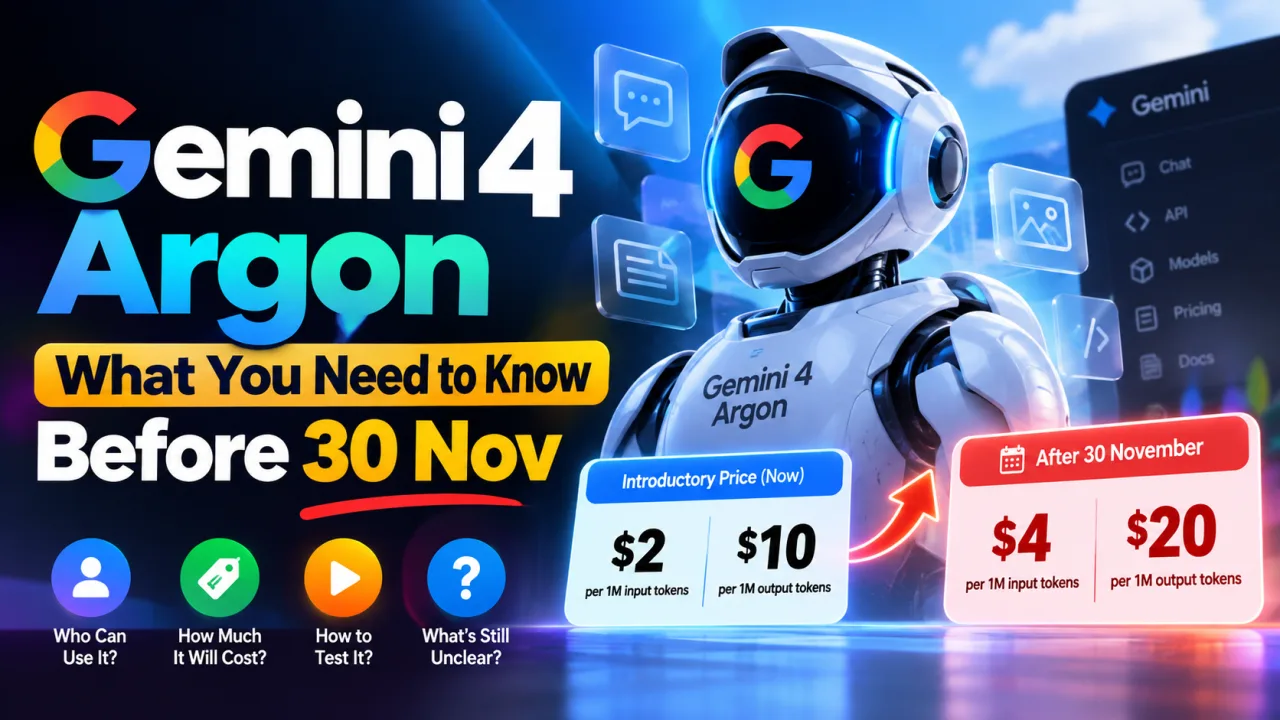
Gemini 4 Argon’s introductory price is currently $2 per million input tokens and $10 per million output tokens, and after the introductory period it will become $4 and $20, a date that one report gives as 30 November. For anyone who works with the API the question is simple: how much will the bill go up, and does the model deliver that much? This post has only the things that are written in official sources: when the model arrived, who gets it, how to work out the cost, and which things are still unclear. One thing I should say upfront: I did not get the chance to work on this model myself, so there is no personal result here.
What Gemini 4 Argon is and when it arrived
Google announced Gemini 4 Argon on 30 September 2026. Google describes it as its frontier model, built for real-world software engineering, enterprise knowledge work like legal and finance, and cybersecurity defense.
At first it went only to a chosen few. On the day of the announcement, Argon reached trusted cyber defenders through the Fairwind Program, and Google wrote that it is also part of the US government’s voluntary pre-release process. The door opened for ordinary developers on 13 October 2026, when Google said that work with Argon could begin on the paid Gemini API.
Google also gave an example of its own internal work. In an open source video decoder called libgav1, Argon agents replaced 32 thousand lines of SIMD code, and according to Google the new Rust version runs 2.7 times faster than the earlier Rust port. This is Google’s own claim and has not been confirmed by any independent test, so keep that in mind.
The price and the question of 30 November
Google’s announcement gives the introductory price as $2 per million input tokens and $10 per million output tokens. Cached input tokens get a 95% discount on the input price. After the introductory period ends, the price will become $4 per million input tokens and $20 per million output tokens, meaning both rates double.
Now the question of the date. Google’s own post does not state an end date for the introductory period. A PYMNTS report says the price will double after 30 November, and that is why this post’s title has that date. In my opinion, before planning anything big you should look at Google’s official pricing page once.
A token is a small piece of text that an AI model reads and writes. An input token is what you send to the model, and an output token is what the model writes back. Let’s understand the calculation with an example. Suppose a project uses 5 million input tokens and 1 million output tokens in a month. At the current price, input costs 5 × $2 = $10 and output costs 1 × $10 = $10, a total of $20. At the later price, input is 5 × $4 = $20 and output is 1 × $20 = $20, a total of $40.
This is not the bill of any real project, just an example to show the calculation. The 95% discount on cached tokens has not been added in, so for jobs where the same long instruction is sent again and again, the bill could come out lower than this example.
Who gets access
The official posts show two routes, and the third is mentioned only in one report.
- The paid tier of the Gemini API, in Google AI Studio and Android Studio. This is written in Google’s developer post of 13 October.
- For Google AI Ultra subscribers, in AI Studio and Google Antigravity. Antigravity is Google’s agent-first development platform, meaning a place where the AI does coding work for you across many steps by itself.
- In the Gemini app and Search, for Ultra and Pro subscribers. This is written in a weekly roundup, not in Google’s developer post.
I did not find any official information about free users. I also do not know for sure what the price or plan will be in India, and this is a weakness of mine, that I could not check the India plan page of the Gemini app. Before you subscribe, check in the app whether Argon shows up in your account, because Google itself has said it is widening access gradually.
What the 1 million output token limit means
Google has raised Argon’s output limit from 64 thousand tokens to 1 million tokens, which is more than 15 times. The output limit means how much the model can write in a single answer. It makes a difference in long coding, big documents and multi-step work, because the model can do the whole job in one trajectory without stopping in between. I did not find a number for the input context window in Google’s announcement.
More output also means more cost, because the rate for an output token is five times the input rate ($10 against $2). I feel that for small everyday questions this limit will show no benefit. It is meant for people who get a whole module, a long report or a code migration written in one go.
Google’s benchmarks: do they really matter
Google has given several scores in the announcement. 77.9% on DeepSWE v1.1, which measures real-world long software engineering tasks. Rank #1 on Zapier’s AutomationBench with 51.3%. 91.7% on LVBench, a test of understanding long videos. A tie for first place on CWE-bench v1 with 68%, which measures the ability to fix security vulnerabilities. On the Vals Index too, Google has called Argon leading, and that index judges work in finance, coding, legal and tax.
All of these numbers are given by Google. A weekly roundup on Medium puts Argon at 5th rank on the Arena Overall leaderboard and at 52.8% on CursorBench, which is on par with Claude Opus 5.5. In my view these numbers should be read as a hint. Writing a resume or a Hinglish caption cannot be measured by a coding benchmark, so instead of changing your plan after looking at a leaderboard, it is better to run a test on your own work.
How to test it on your own work
The method of testing is simple: give the same task to Argon and to the AI you use now, and read both answers side by side. Five jobs are enough: bullet points for a resume, a small code bug, a summary of long notes, a Hinglish Instagram caption and a 30-day study plan.
For the coding test, this prompt will work:
This code of mine is not working. First find the bug, then fix it, and tell me in one line what the mistake was.
Paste your real code into this, not an example taken from the internet. In the answer, see whether the bug was caught on the first try, and whether the explanation was clear enough that you could fix it again yourself.
In the resume test, see whether the model is only changing words or whether the bullet points are really improving. If the model adds numbers that you never gave, that answer is no use. In the notes test, see whether any important points were left out of the summary.
In the study plan test, check one thing for sure: open the links or resources the model gives, and look at them yourself. AI sometimes makes up links that do not exist at all.
In the Gemini app everyone now gets low, medium and high thinking levels, as a weekly roundup says. Run the same prompt on a hard task at all three levels. If the answers at low and high come out the same, then low is enough for everyday work. Write down the answer and the time taken for each test in one place, so that the decision is made from the record and not from memory.
Limitations, risk and privacy
The biggest limitation is access. Google itself has written that before a broad rollout it is strengthening safeguards and widening access gradually. So it may be that Argon does not show up in your account or region yet, even if others are using it.
The second matter is price. After the introductory period the rate is $4 and $20, and if your app or tool depends completely on Argon, you could be in a difficult spot when the price goes up. So build the integration in a way that makes it easy to change the model.
On safety, Google has said that the model is designed to refuse harmful requests, to stop cyber or CBRN misuse. Work has also been done on protection against prompt injection. Prompt injection means instructions hidden in some webpage or document that get the AI to do work outside your intention. If you put Argon in an agent that reads emails or websites, do not give it direct access to jobs like payments or deletion.
Another weakness is that I cannot judge the cyber defense part myself. Google’s announcement says trusted defenders are being given Argon without cyber guardrails, and Google has not mentioned this version for other users. For an ordinary user, this part only means that the security benchmark scores do not apply directly to their everyday work.
A straight rule on privacy: stop before pasting a resume, a bank statement, Aadhaar or any personal document into an AI. How your data is stored and who can see it depends on the privacy policy of that plan, and you must read that policy yourself. For me this is the most important check, because you have less control over data once it has been sent.
Who this is for and who it is not for
Developers who work on the paid Gemini API will find this post the most useful. The 30 November price change affects their bill directly, so they should test before the date and work out their numbers. For freelancers and small teams who do coding or long documents, the 1 million output limit can be useful, because getting a whole module or report written in one go saves their time. Students and ordinary users who use only the Gemini app have nothing to do with the API price. They only need to see whether Argon comes with their plan.
For those who only want to ask small everyday questions, there is no need to change plans in the name of a new model, because there is no proof that they will see a difference in that kind of work. For those who do not have paid API or Ultra or Pro access, this post is for information only for now, because the routes written in Google’s posts are these first.
ChatGPT Dots: What Is It? My Real 2-Day Experience
MiniMax H3 Explained: The Open-Source AI Video Generator Everyone's Talking About
What Happened at AI Infra Summit 2026? Complete Recap (Santa Clara, Sept 15–17)