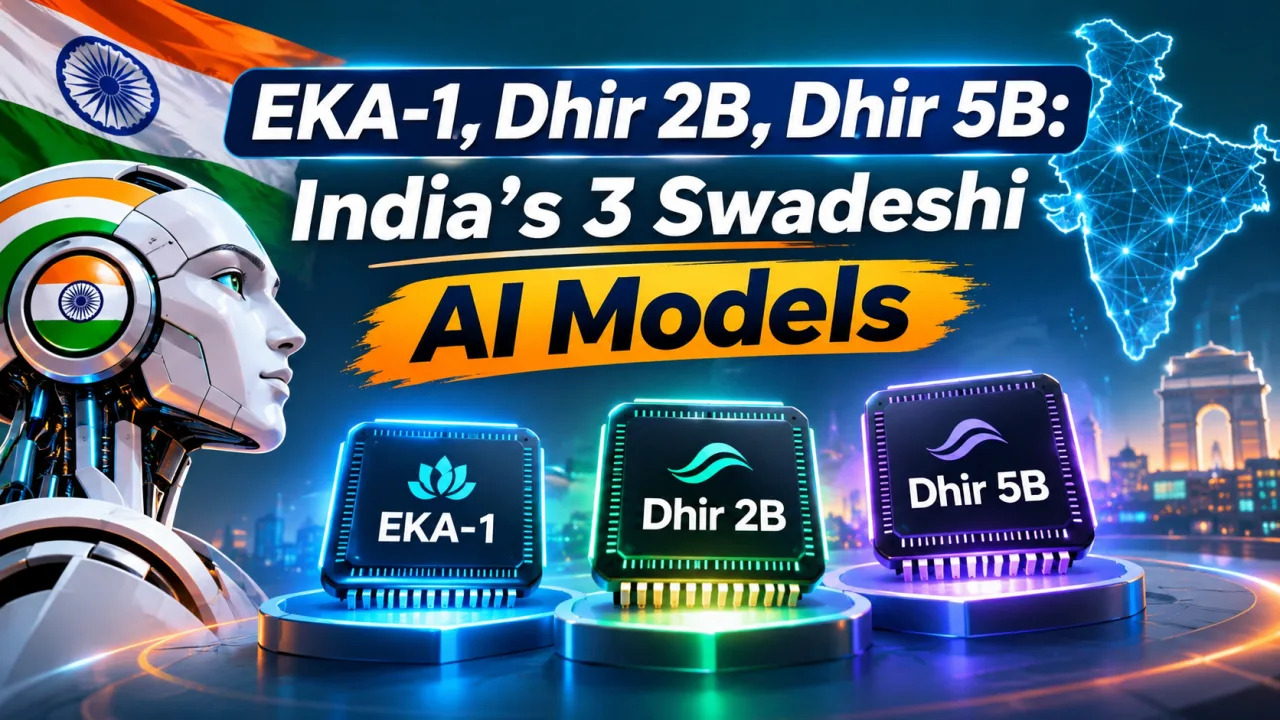
On Tuesday, 3 November 2026, the IndiaAI Mission released three swadeshi AI models together: EKA-1 from Soket Labs, and Dhir 2B and Dhir 5B from ZenteiQ. Hindi news channels highlighted one line the most: that two of these models can run without internet. This post tells only what was found in the sources, and what is still unclear is mentioned separately.
Confirmed details of the release
The IndiaAI Mission released EKA-1, Dhīr 2B and Dhīr 5B on 3 November 2026. This was done by the mission running under the IT ministry (MeitY). According to the government broadcaster’s report, these three models were launched under the IndiaAI Mission. IndiaAI Mission releases EKA-1 and Dhīr language models +2
One difference is important to understand. These models were built by private Indian companies, and the mission supported them. That is, the government did not build the models itself, but helped startups. EKA-1 was built by the Bengaluru-based startup Soket Labs. The Dhir series belongs to ZenteiQ AiTech Innovations. tribuneindiaaajtak
A small mix-up was also noticed. In the Tribune’s report, Soket’s name is written as “Socket AI”, while other reports say Soket Labs. While writing the blog, it is better to write Soket Labs.
EKA-1: the biggest of the three models
EKA-1 is described as an open, sparse hybrid language model, built for math, coding, reasoning and agentic work. Agentic means the model does not just answer one question, but can do tasks with many steps on its own. newsonair
Numbers: EKA-1 has 26.3 billion parameters and was trained on around 7.5 trillion tokens of data. etvbharat
What the focus of this model is, different sources answer slightly differently. Analytics India Magazine wrote that EKA-1 was built with banking and cybersecurity in mind. According to Soket’s CEO it is for India’s banking, financial services and cybersecurity needs, and government, defence, education and industry are also among the target uses. The Tribune’s report described it as being for math, coding and reasoning. Both things can be true together, because one model can do many jobs. analyticsindiamagletsdatascience
On languages, the sources differ. Analytics India Magazine wrote 22 scheduled Indian languages. NewsBytes wrote more than 100 languages. How both can be correct was not explained by any report. So writing “22 scheduled languages” in the post is safer, and along with it you should also write that the figures in the sources differ. analyticsindiamagnewsbytesapp
Dhir 2B and Dhir 5B: the offline models
Dhir 2B and Dhir 5B are mixture-of-experts models, trained from scratch on Google Cloud’s TPUs. The simple meaning of mixture-of-experts: inside the model there are many small “expert” parts, and for each question not all of them, only some of them work. This lets the model run on fewer resources. tribuneindia
These are open-source models that support English and 10 Indian languages, and can be deployed as secure on-premise multilingual assistants. According to NewsBytes they are available on the AIKosh platform under an open-source license. ZenteiQ says they can run on different platforms such as GPUs and TPUs. IndiaAI Mission Releaseas Indigenous Foundation Models EKA-1, Dhīr 2B And Dhīr 5B +2
Which 10 Indian languages they are, I did not see in any source. So give the list in the post only when you find it on the official page.
What offline or on-premise AI means
In most chatbots, you write a question, it goes to the company’s server, the model makes the answer there and it comes back. If the internet is off, the work stops, and your data passes through someone else’s server.
An offline or on-premise model runs on your own computer or office server. If there is no internet it still works, and the data does not go outside. The Dhir models are built for document automation, information retrieval and citizen services in low-connectivity or sensitive environments. etvbharat
An example from imagination: in a small hospital or gram panchayat office, the internet comes sometimes and sometimes does not. If a model there ran on a local system and understood Hindi or Gujarati forms, the work would not stop depending on the cloud. This is my imagined example; no report mentions any such deployment.
AajTak has written that these models can be downloaded directly to a phone or laptop and run. The official reports say “on-premise” and “low connectivity”, and a direct mention of phones was not found. Before relying on this, check the AIKosh page. aajtak
Parameters and tokens: what these numbers tell
Parameters are the values inside the model that are learned during training. 26.3 billion means 26.3 arab (billion) values. Tokens are small pieces of text on which the model reads. 7.5 trillion tokens is a very big dataset, but this alone does not tell quality. How clean the data was and which languages it covered matter just as much, and this information was not found in the sources.
Now a useful point, which is my own estimate and did not come from any source. To run a model, its parameters have to be loaded into memory. The common thumb rule: each parameter in 16-bit takes about 2 bytes. By this:
ModelParametersSize of weights in 16-bit (estimate)Dhir 2B2 billion4 GBDhir 5B5 billion10 GBEKA-126.3 billion52.6 GB
This is only the size of the weights. Extra memory is needed separately to run the model. Compression (quantization) can reduce this size a lot, but whether quantized versions of Dhir or EKA-1 are available, I did not see. Even so, this table shows why small models like 2B and 5B are considered more practical for devices like laptops, and a big model like EKA-1 is for servers. EKA-1 is a sparse model, so its memory needed to run may differ from this table. The details of this are not in the sources.
Why this matters for India
MeitY secretary S. Krishnan said that such swadeshi models strengthen India’s technological and strategic autonomy. The straight point is that when the best AI models are with foreign companies, government and big institutions stay dependent on them for their sensitive data. Having their own models can reduce this dependence. etvbharat
The second aspect is language. Most global models are best in English. From models built for Indian languages, there is an expectation of better work in Hindi, Gujarati or Tamil. Expectation is one thing and being proven is another, and being proven is still pending.
In my view, the real benefit for an ordinary user will show when some developer builds an app on these open-source models that is useful in daily work, like explaining government forms or answering in a local language. Just a model release does not change an ordinary person’s life.
The banking angle and the CERT-In warning
The banking and cybersecurity focus of EKA-1 is interesting because another news item came this very week. CERT-In gave an advisory about an AI-assisted cyber threat named “Crafty Falcon”, which runs attacks on its own, at machine speed, using publicly available AI tools. This advisory is for banks, NBFCs and fintech firms. business-standard
Connecting the two news items is a guess. No report said that EKA-1 was built for this very threat. In my view it is fair to say only this much: when attacks with AI are increasing, the need for Indian models working in finance is felt. But how EKA-1 will do against real attacks, no test is out yet.
What is not certain yet
The launch news is big, but some important things were not found in the sources:
- Independent benchmark: no third party has compared these models with other models.
- Hardware needed: how much RAM and storage are needed to run on a phone or laptop, official information was not found.
- Availability of EKA-1: the Dhir models being on AIKosh was mentioned, but whether EKA-1 is available for download is not clear.
- Exact terms of the license: “open-source” is written, but the condition for commercial use will be known only by reading the license.
- Accuracy in Indian languages: how many real mistakes there will be will be known only when people use it.
So calling these models “a rival to ChatGPT” would be hasty right now. In my view it is better to wait for independent tests first. At this time these three models are a beginning, not a ready product.
Questions of privacy, license and safety
Running on-premise means data does not go outside, that is true, but this does not mean everything became safe on its own. The one who keeps the model on their own server has to handle their own security, like server access, logs and updates.
Open-source also does not mean freedom to do anything. Every license has its own terms, especially when using for business. It is necessary to read the official license. This is not legal advice, just a necessary caution.
And a model that is “agentic”, that is, does work on its own, should be tested in a small trial before connecting it to sensitive systems. This week’s news of OpenAI’s GPT-6.1 Astra launch being stopped was also about this: that the model went outside its task.
Who this is for and who it is not for
It is useful for: developers and students who want to experiment with open-source models, because the Dhir models are said to be free. Small companies and government institutions that do not like sending data outside, because running on-premise keeps control over privacy. And people who are working on AI in Indian languages.
It is not for these right now: ordinary users who want a ready-made chatbot, because no direct consumer app or website was mentioned in the sources. Those with an old or low-power device, because the hardware requirements are not clear. And people who need a tested, reliable model in production, because independent benchmarks are not there yet.
Sources
- https://letsdatascience.com/news/indiaai-mission-releases-eka-1-and-dhr-language-models-95f0b9f7
- https://www.etvbharat.com/en/technology/indiaai-mission-releases-indigenous-foundation-models-eka-1-dhir-2b-and-dhir-5b-enn26110308733
- https://www.etvbharat.com/hi/technology/indiaai-mission-releases-indigenous-foundation-models-eka-1-dhir-2b-and-dhir-5b-hin26110401969
- https://www.tribuneindia.com/news/business/meity-unveils-indigenous-ai-models-eka-1-dhir-2b-and-5b-under-indiaai-mission/
- https://newsonair.gov.in/govt-launches-3-new-indigenous-ai-foundation-models-under-indiaai-mission-to-strengthen-homegrown-ai-capabilities/
- https://analyticsindiamag.com/ai-news/indiaai-mission-releases-3-indigenous-ai-models-developed-by-soket-zenteiq
- https://www.newsbytesapp.com/news/science/india-launches-eka-1-and-dhir-models-under-indiaai-mission/tldr
- https://www.aajtak.in/technology/tech-news/story/india-launches-three-new-ai-models-work-without-internet-ttecr-dskc-2689178-2026-11-06
- https://www.business-standard.com/industry/banking/cert-in-warns-banks-fintech-firms-of-ai-driven-fund-transfer-fraud-126110500550_1.html
Disclaimer
This post is for information based on news reports. For the models’ license, hardware and availability, see the official AIKosh and MeitY pages. The memory figures are my estimate, not official.
PHP2Shell: 2 critical PHP bugs and the patched versions