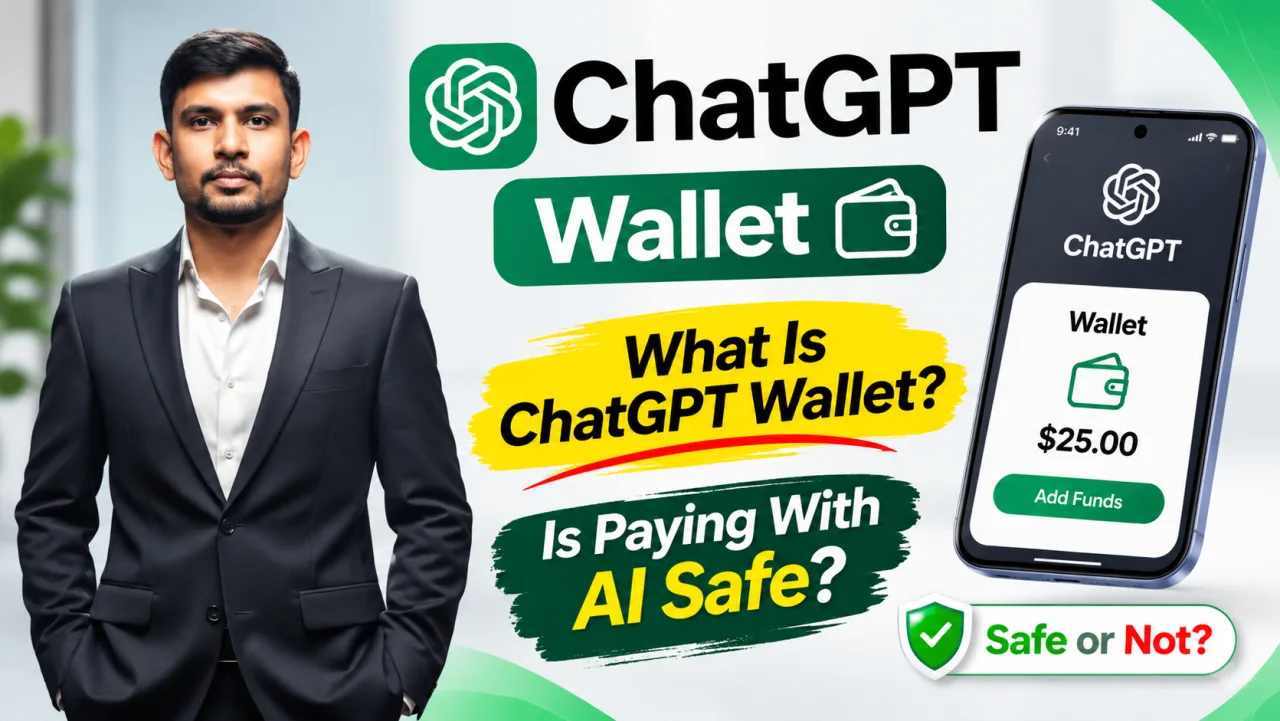
OpenAI started rolling out ChatGPT Wallet on 13 November 2026. With it, OpenAI’s “dots” AI agents can complete an online checkout on your behalf, and they never get your real card number. For now, it is available only to ChatGPT Pro users in the US. Below, you will find how it works, how safe it is, and what it means for readers in India.
What is ChatGPT Wallet?
ChatGPT Wallet is OpenAI’s payment feature. It lets a dots agent finish checkout on an online shop.
Dots are OpenAI’s personal AI agents, which the company introduced in September and which keep working in the background. Until now, an agent could find a product, but you had to make the payment yourself. With Wallet, you add your card once, and the agent completes the payment using it, but your real card number never reaches the agent. The feature was built together with American Express, Mastercard and Visa.
Wallet does not work in a regular ChatGPT chat. It works only inside dots conversations.
How does ChatGPT Wallet work, step by step?
The whole process runs in six steps.
1. You add your credit card once. This is done in the Wallet settings or at checkout, through a secure form.
2. The dot searches for an item and reaches checkout. It does not rely on a separate retailer integration. It works on the normal payment form of an ordinary storefront.
3. Before approval, you see the merchant name, the items, the total amount and the card you chose.
4. You approve it with a security check such as Face ID or fingerprint.
5. The card network (Visa, Mastercard or Amex) creates a payment token.
6. The payment goes through the token, and the money is charged to the card you chose.
At no point on this path did the agent or the shop see your real card number.
What is a payment token?
A token is a stand-in card number. It has its own card number, security code and expiry date, and it works in place of your real card. According to CNBC, the token is set for one specific transaction.
For example (this is an illustration made to explain the idea, not a real user’s experience): suppose a US user asks their dot to order a pair of running shoes worth $60. The dot reaches checkout and settles the order, and the user approves it with Face ID. The shop never gets the real card number. It sees only the separate number and code that were created for that order.
Who can use ChatGPT Wallet right now?
At launch, it is for ChatGPT Pro subscribers who are 18 or older, are in the United States, and hold an eligible card issued in the US. Only credit cards work. Debit cards and virtual cards are not supported at launch. For a Chase card, the card must belong to the primary cardholder, and that person approves the link in the Chase mobile app, according to WebProNews.
OpenAI is not charging any transaction fee for this feature at launch. No information was found about other plans.
Is ChatGPT Wallet safe?
On the card number side, the design puts two barriers in place. First, the agent and the shop get a token, not the real number. Second, every purchase needs your approval first. OpenAI says card rewards and the protection for eligible disputes also stay in place.
A TechTimes report makes one more point: the Face ID approval is the last human check on a purchase, and the token protects the card number, not the decision to buy. For example (this too is an illustration made to explain the idea), if a dot picks the wrong size or a higher-priced item and the approval screen is tapped without reading it, the token will not stop that mistake.
These things help you stay safe:
• Before approving, read the item, quantity, size and total price.
• Check the merchant name, and do not approve on an unfamiliar site.
• Keep SMS or app alerts turned on for that card.
• Start with small orders.
• Keep matching every charge on your bank statement with the order.
How far the dispute protection applies will be clear only after you read your card issuer’s terms.
Where can things go wrong?
Amazon, eBay and some other companies restrict outside AI agents on their sites. Fraud detection systems also sometimes reject a valid purchase, and OpenAI itself has admitted that this can happen. So it is not certain that every dot order will go through.
Will ChatGPT Wallet come to India?
I could not find any official announcement about this. The launch details cover only US Pro users and cards issued in the US. Reports did not mention Indian cards or UPI. So do not rely on any date or feature claim, and update this post when OpenAI’s official announcement arrives.
Who is ChatGPT Wallet for, and who is it not for?
Pro users in the US who regularly place online orders or bookings through a dot save checkout time, and they do not have to share their card number again and again. It is also worth understanding for online sellers and developers, because Wallet works on ordinary checkout forms and no shop has to build a separate integration. For people who follow AI commerce, this is a new step.
For users in India, it is not available yet, because the feature is limited to the US. People who want to pay with a debit or virtual card are also left out for now, because neither is supported at launch. It is also not right for people who are in the habit of tapping an approval screen without reading it, because in this system that screen is the last check.
Sources
https://9to5mac.com/2026/11/13/openai-launches-chatgpt-wallet-enabling-dot-agents-to-make-purchases/
https://www.cnbc.com/2026/11/13/openai-chatgpt-wallet-dot-purchases.html
https://www.webpronews.com/openai-chatgpt-wallet-dots-agents-payments
https://finance.biggo.com/news/807144f0-4e0a-424a-872a-92d29ddb764a
https://transclew.com/tech/chatgpt-wallet-ai-agent-card-payments/
Disclaimer
This post is for information only and is not financial or legal advice. The feature is new, so check OpenAI’s and your card issuer’s official terms yourself; this draft was prepared with the help of Claude (Anthropic), which is a competitor of OpenAI.
EKA-1, Dhir 2B, Dhir 5B: India’s 3 lunch AI Models