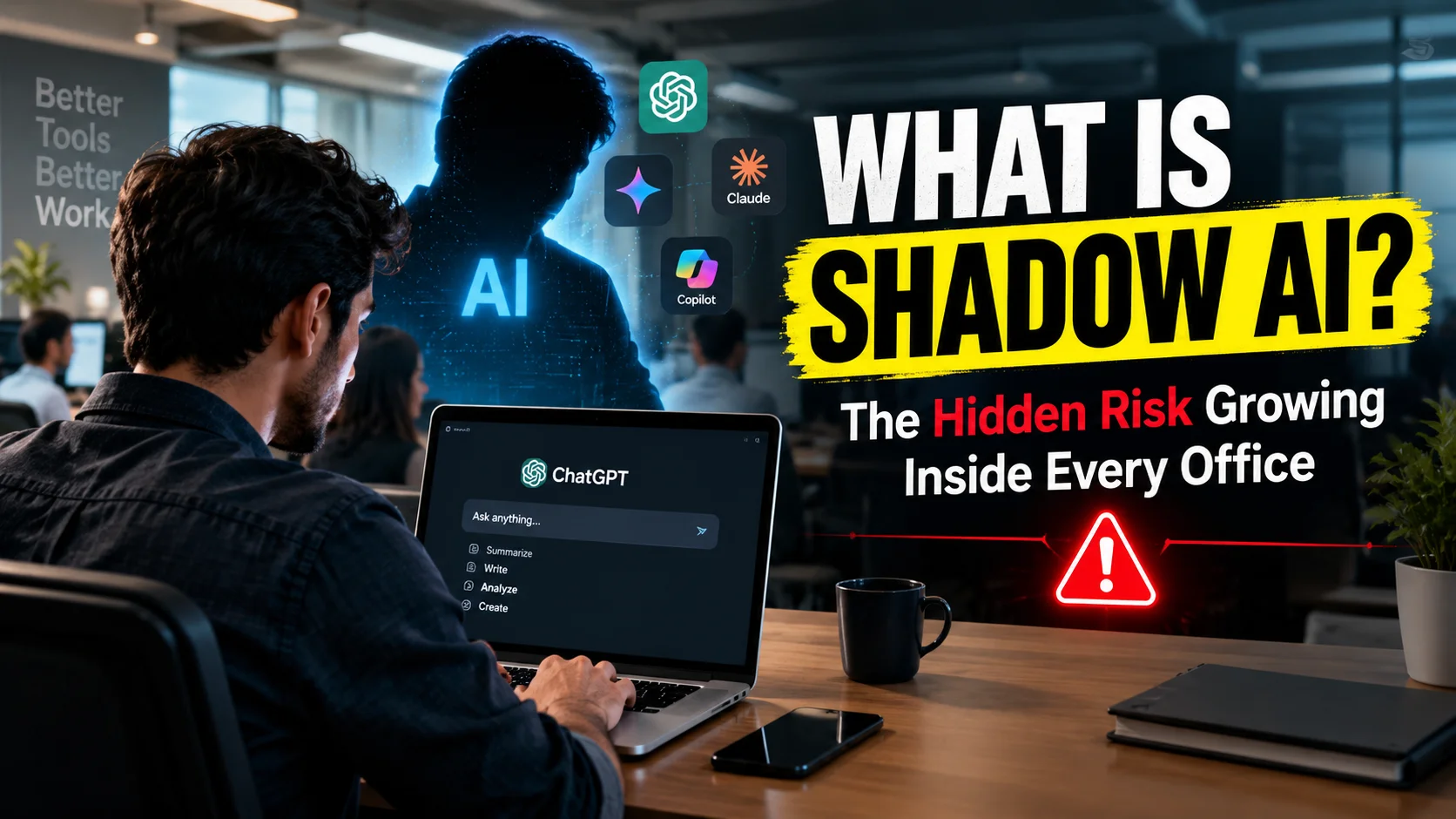
What Is Shadow AI? The Hidden Risk Growing Inside Every Office
A friend of mine works as a finance analyst at a mid-size company. To get through his workload faster, he copies sales figures and client details into his personal ChatGPT account almost every day. His IT department has no idea this is happening.
When I asked him whether anyone at work knew about it, he shrugged and said, "They never gave us a proper tool for this, so I just use my own. Pretty much everyone does."
That right there is Shadow AI — and if you think this is a problem limited to big tech companies, the numbers from 2026 might change your mind.
What Shadow AI Actually Means
In simple terms, Shadow AI refers to employees using AI tools at work without their company's knowledge or approval. This could be a chatbot like ChatGPT, Claude, or Gemini, a browser extension, or an AI-powered coding assistant.
The concept itself isn't new. It's essentially the AI-era version of "Shadow IT," which described employees quietly using unauthorized apps like Dropbox years ago. But Shadow AI carries a much bigger risk, because whatever you type into an AI tool can potentially be stored, logged, or in some cases even used to train that company's models.
The Numbers Behind the Trend
These aren't guesses — they come from recent 2026 industry research:
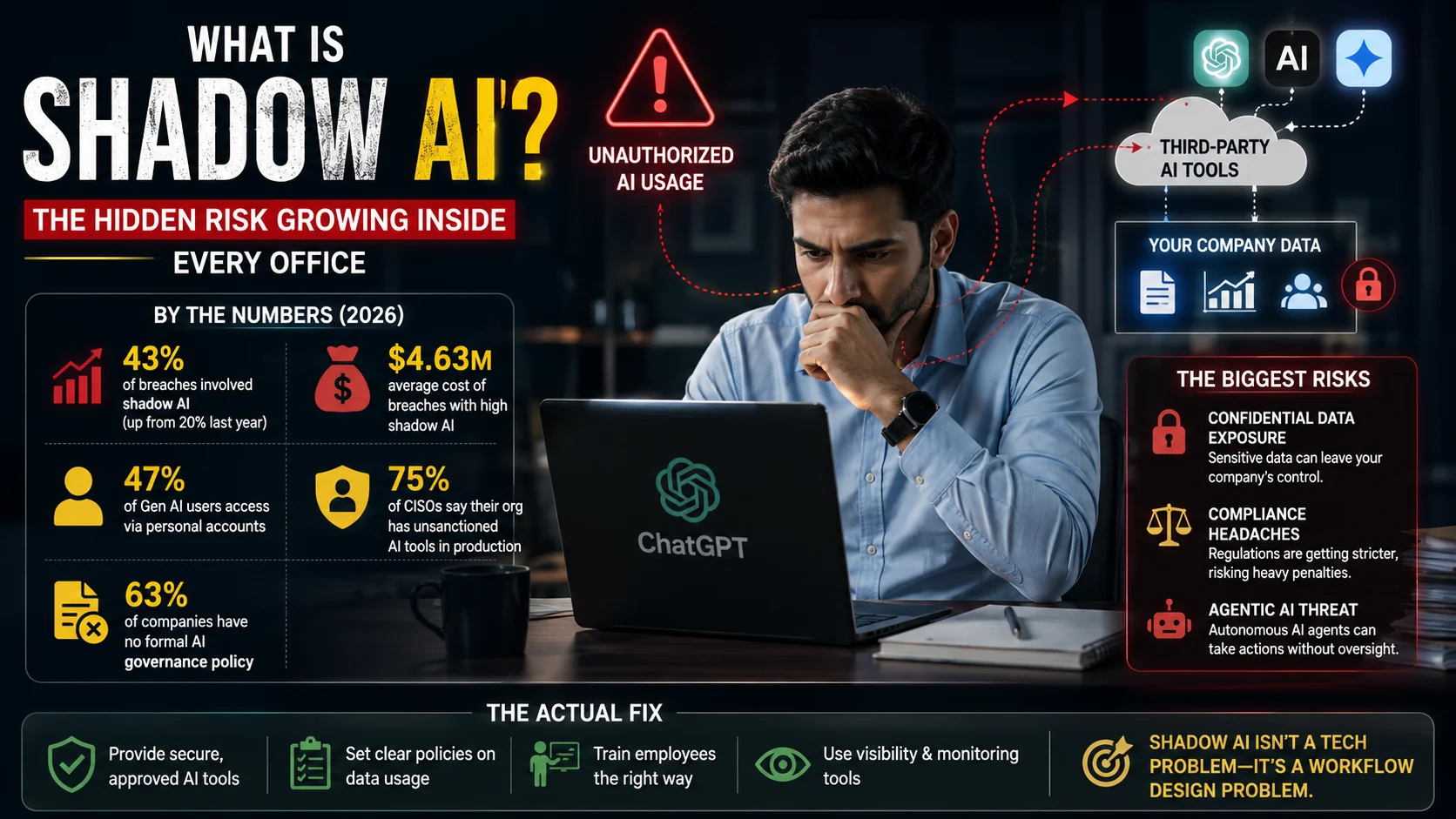
- According to IBM's 2026 Cost of a Data Breach Report, shadow AI played a role in 43% of breached organizations, up sharply from 20% the year before — meaning the problem has more than doubled in just twelve months.
- Breaches involving high levels of shadow AI cost organizations an average of $4.63 million, roughly $670,000 more than breaches with little or no shadow AI involved.
- Nearly 47% of generative AI users access these tools through personal accounts, which means their employer has zero visibility into what's happening.
- In a survey of security leaders, 75% of CISOs admitted their organization already has unsanctioned AI tools running in production — and another 16% weren't even sure.
- Multiple reports found that roughly 63% of companies still don't have any formal AI governance policy in place.
This isn't confined to tech firms either. Healthcare, finance, legal, and retail are all seeing the same pattern play out.
Why Employees Do This
It's worth pointing out something important here: most employees aren't doing this maliciously. They're not trying to sabotage their company. The real driver is simple — speed and convenience.
Think about it from their side. If a company hasn't provided an approved AI tool, or the one they did provide feels slow and limited, what does an employee do? They open their own ChatGPT app and get the task done in two minutes. Survey after survey backs this up — when employees are asked why they turn to unapproved tools, the most common answer is that the approved options simply don't work as well as what they already use at home.
There's another telling detail here too. Even when companies ban AI tools outright, close to half of employees admit they keep using them anyway, just more quietly. In other words, banning AI doesn't solve the problem — it just pushes it out of sight.
The Biggest Risks Involved
1. Confidential Data Exposure
When an employee pastes client information, proprietary source code, or an unreleased product roadmap into a public AI tool, that data leaves the company's control entirely. Many legal teams now treat content generated by unmanaged AI tools as "IP-suspect," meaning it carries uncertain intellectual property status and shouldn't be used without careful review.
2. Compliance Headaches
Regulations like the EU AI Act are becoming stricter, with high-risk system obligations arriving in August 2026. If a company has no idea where its data is going, proving compliance becomes nearly impossible — especially in sensitive areas like hiring, healthcare, or credit decisions.
3. The New Threat: Agentic AI
This isn't just about chatbots anymore. Newer AI "agents" can independently carry out multi-step tasks — sending emails, accessing files, or making changes inside enterprise systems. When these operate without any oversight, the potential damage grows significantly.
So What's the Actual Fix
Here's where most experts agree: banning AI outright is not the solution. The more effective approach looks like this:
- Provide secure, approved AI tools that are just as fast and useful as what employees already use, so there's no reason to look elsewhere
- Set clear, simple policies about what kind of data can and cannot go into AI tools
- Train employees properly — a large number of people genuinely don't realize what they're doing is risky
- Use visibility and monitoring tools so the company actually knows which AI tools are in use across the organization
As one industry report put it well — shadow AI isn't fundamentally a technology problem, it's a workflow design problem. Employees go around the system when the system doesn't meet their actual needs.
The Bottom Line
Shadow AI might sound like just another buzzword, but the 2026 data makes it clear this is a real and rapidly growing risk. It's not something only CISOs or IT departments should worry about — every employee, manager, and business owner should understand what safe AI use actually looks like.
So here's a good next step: ask around your own workplace, "Which AI tool are we officially allowed to use?" If the answer is "not sure," there's a good chance Shadow AI is already happening right under your nose.
ChatGPT Tools Explained: What Does Each Option Do? A Beginner’s Guide
When was Antigravity 3.7 launched, and what changes were made?