
What is Claude AI and Who Made It? Full History Explained (2026)
Currently in the world of AI, the most talked-about name after ChatGPT is "Claude." If you spend even a little time on social media, this name must have definitely reached your ears. When I myself first heard this name, I felt a bit curious about what it actually is, and that same curiosity is what pushed me to understand this whole topic in depth. Today I'm going to share that same understanding with you — where the idea to make Claude came from, who made it, what it can do, and how it is different from other AI tools.
Let's start with the basics and slowly go deeper.
What is the company Anthropic, and what is its relationship with Claude?
What is Claude?
Claude is an AI that talks with people through text, answers questions, creates research or documents for you, codes tools, websites or apps, analyses data, and does a lot more. To put it simply, it is a Large Language Model (LLM) — a system that has been trained on vast internet data so that it can understand and answer in any language.
What is Anthropic?
Anthropic is the company that made Claude.
Let's understand with a simple example: just as Google made "Gemini" and OpenAI made "ChatGPT," in the same way Anthropic made "Claude." This is the simplest way to understand the relationship between the two.
When and how was Anthropic made?
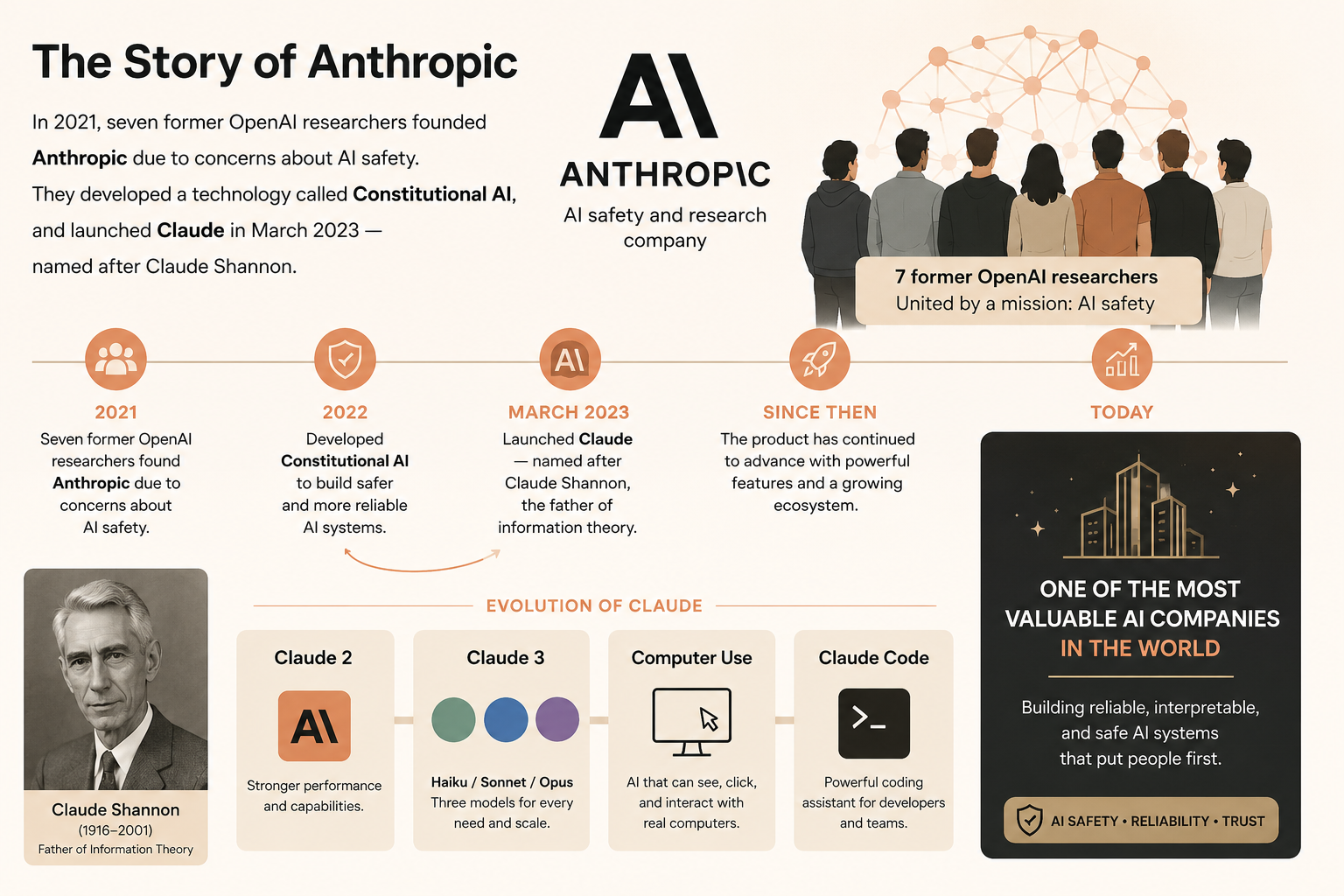
Anthropic was founded in January 2021. Its founders are from San Francisco, California (USA), where its main office is located. It is structured as a Public Benefit Corporation (PBC) — a type of for-profit company that promises to take care of public interest along with its own profit.
The main faces behind the founding of Anthropic are the brother-sister pair:
Dario Amodei — CEO of Anthropic. He was previously VP of Research at OpenAI.
Daniela Amodei — President of Anthropic. She was previously VP of Operations at OpenAI.
Besides these two, five other people co-founded Anthropic:
Chris Olah — Known for his work on "interpretability" of AI models.
Tom Brown
Sam McCandlish
Jared Kaplan — He is considered the main mind behind Constitutional AI technology.
Jack Clark — He has played an expert role in policy and government relations.
An interesting thing is that all seven co-founders had previously worked at OpenAI (which made ChatGPT). It's a bit surprising to know, but that's the fact.
Where did the idea to make Anthropic come from?
This question came to my mind too — let's understand it a little more deeply.
Around 2021, while working at OpenAI, Dario and Daniela Amodei felt that AI was moving forward very fast, but not enough attention was being given to keeping it safely under control. In technical language this is called the "Alignment Problem" — meaning making sure that whatever AI does, it does not harm humans.
As this concern grew, they felt that OpenAI was rushing releases without fully understanding it, and that this pace could prove dangerous in the future. For this very reason, together with the five colleagues mentioned above, they left OpenAI and made their own company — with the mission of becoming a "safety-first AI company," which puts safety before speed and profit. This is how the idea of Anthropic came into existence, and the company was founded.
How did Claude get this name?
The name Claude is taken from Claude Shannon, who is known as the "father of Information Theory." In 1948, he laid the mathematical foundation on which today's entire digital world — computers, internet, data communication — is based. By naming its AI after him, Anthropic made it clear that its focus is on rigorous, foundational science.
What is Constitutional AI? The key to Anthropic's biggest success is that they paid the most attention to safety.
Constitutional AI is a training method that Anthropic developed in December 2022, which makes AI models safe and helpful.
This process happens in three stages:
The AI model is given a list of "rules" — such as "don't give harmful answers," "be honest," "respect human rights." Many such rules take care of our data and safety.
The model checks its own answers according to these principles and improves them.
Then reinforcement learning is done using this self-generated feedback — which reduces dependency on human evaluators at every step.
This method is considered more scalable and transparent than traditional RLHF (Reinforcement Learning from Human Feedback).
What all has happened with Claude since 2023?
March 2023 — Claude was launched for the general public for the first time (Claude and Claude Instant)
July 2023 — Claude 2 launched, with a larger context window (~100,000 tokens)
March 2024 — Claude 3 family launched — Haiku, Sonnet and Opus tiers
October 2024 — "Computer Use" feature introduced — Claude could work by seeing the screen
2025–2026 — Claude 4 family, Claude Code, Claude in Chrome, Artifacts, and Excel/PowerPoint integrations
Wondering what Haiku, Sonnet, and Opus are?
Many people initially find these names a bit confusing — let's understand in simple language:
Haiku — the fastest and cheapest, for simple tasks
Sonnet — balanced, combining both speed and intelligence
Opus — the most powerful, for complex tasks
The interesting thing is that all these names are taken from forms of poetry — haiku, sonnet, and opus are well-known poetry types in literature.
How does Claude work?
The Claude model has been made as a Large Language Model (LLM), which has been trained on a huge amount of text data. After training, based on the patterns learned during training, it predicts and generates the answer token by token.
Transformer Architecture
All modern LLMs (including Claude) are based on the Transformer architecture, which was introduced by Google's researchers in 2017. Its main feature is the "Attention Mechanism" — the model's ability to decide which words in a sentence are most related to each other. Which word comes after which word, spelling, sentence structure — it understands and creates all of this on its own.
What all can Claude do, what are its features?
Text Generation — blogs, emails, stories, scripts, and a lot more
Coding — writing code, debugging and building projects
Data Analysis — analysing spreadsheets and CSVs, and making charts
Document Handling — creating and editing Word, Excel, PDF, and PowerPoint documents
Web Research — getting up-to-date answers using live internet data
Artifacts — showing code, websites, or diagrams in a separate sidebar
Vision — understanding images and screenshots
Computer Use / Agents — working automatically in tools like browsers and Excel
Conclusion
In 2021, under the leadership of the brother-sister pair Dario and Daniela Amodei, seven former OpenAI researchers along with them founded Anthropic, driven by concern for AI safety. They went on to develop Constitutional AI and launched Claude in March 2023, which was named after Claude Shannon. Since then, the product has kept developing continuously through Claude 2, the Claude 3 family (Haiku/Sonnet/Opus), Computer Use, and Claude Code — and today, Anthropic is one of the most valuable AI companies in the world.