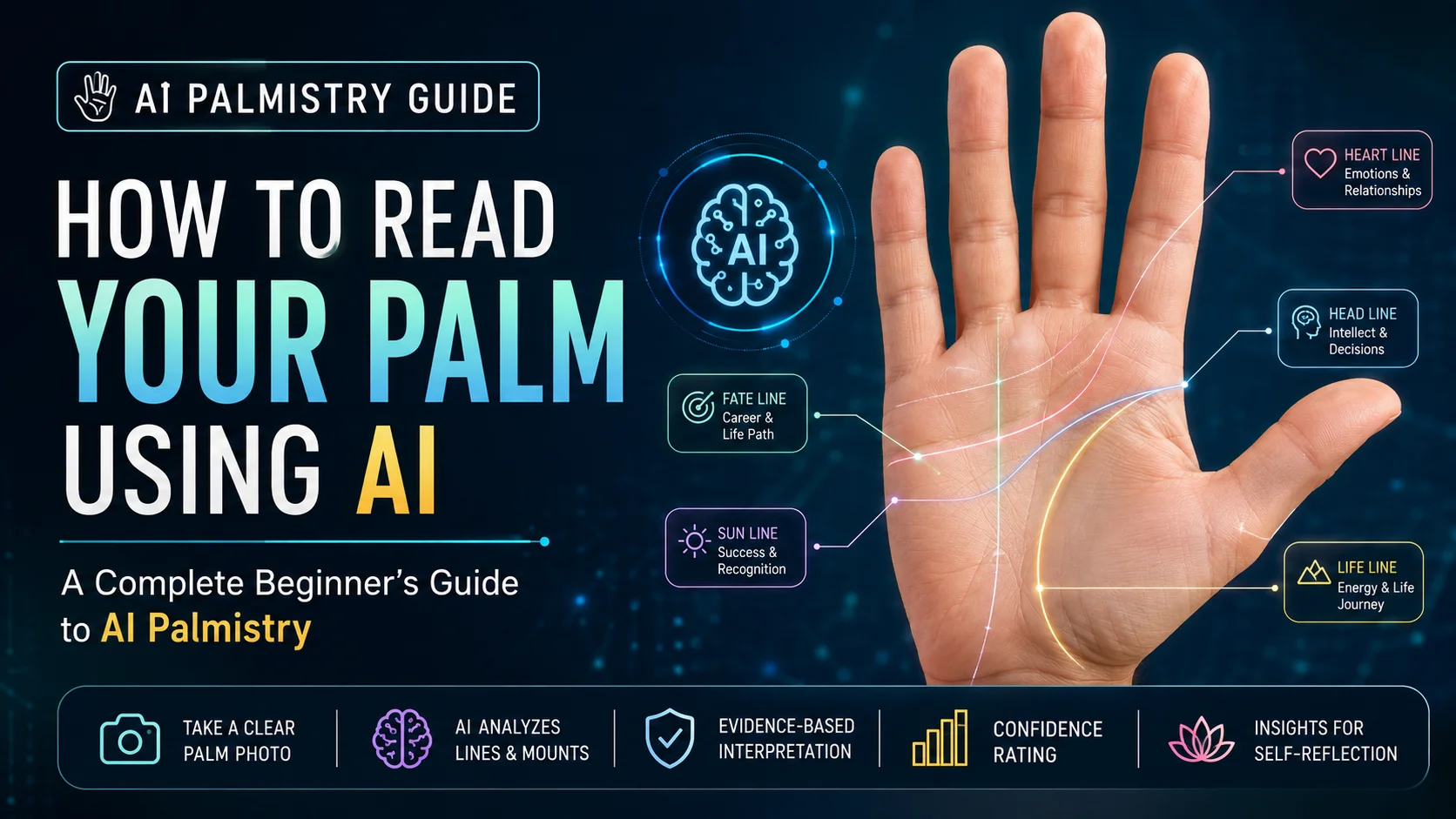
How to Read Your Palm Using AI: A Complete Beginner's Guide to AI Palmistry
Palm reading has been around for thousands of years. Long before smartphones and chatbots existed, people were already studying the lines on their hands, trying to figure out what those little creases could tell them about their personality, their past, and what might lie ahead. Today, that same old practice has found a strange new home — inside artificial intelligence.
If you've ever wondered whether you can actually get a palm reading from an AI tool like Claude or ChatGPT, the short answer is yes, sort of. You won't get a mystical, all-knowing prophecy, but you can get a genuinely interesting, evidence-based look at your palm based on traditional palmistry rules. Here's everything you need to know before you try it.
What Exactly Is AI Palm Reading?
AI palm reading works pretty simply. You take a clear photo of your open hand, upload it to an AI chatbot, and ask it to analyze the visible lines, mounts, and finger shapes using the principles of traditional palmistry. The AI doesn't have any special psychic ability — it's simply trained on a huge amount of text describing what different palmistry traditions say about certain features, and it applies those descriptions to whatever it can actually see in your photo.
That last part matters a lot. A good AI palm reading tool should only talk about what's visible in your picture. If your fingers are cut off in the frame, or your lighting is bad, or a line is too faint to see clearly, it should say so instead of guessing. That honesty is really what separates a useful reading from a gimmicky one.
Step-by-Step: How to Get an AI Palm Reading
1. Take a Proper Photo
This is the part most people rush through, and it's the part that matters most. For a reading that's actually worth reading, your photo needs to show:
- Your full palm, flat and open
- All five fingers and the entire thumb
- Your wrist or the base of your palm
- Even, natural lighting — no harsh flash, no deep shadows
- A straight-on angle, not tilted or at an angle
A blurry, cropped, or poorly lit photo won't give you much beyond guesswork dressed up as insight.
2. Identify Left or Right Hand
Different palmistry traditions treat the left and right hand differently — some associate one hand with inherited traits and the other with traits you've developed through life. Make sure you tell the AI which hand you're showing, or let it figure that out from the photo itself.
3. Let It Map the Major Lines
A thorough AI reading will walk through the main lines on your palm:
- Heart Line – traditionally linked to emotional patterns and relationships
- Head Line – associated with thinking style and decision-making
- Life Line – linked to energy, stability, and life transitions (not lifespan, despite the name)
- Fate Line – traditionally tied to career direction
- Sun Line – associated with recognition and creative expression
4. Check the Mounts
The raised, fleshy areas of your palm are called mounts, and each one is traditionally tied to a different theme — Venus for emotional warmth, Jupiter for ambition, Mercury for communication, and so on. Their size and prominence are said to indicate which traits are more dominant in a person.
5. Get a Confidence Rating
Here's the detail that separates a thoughtful AI reading from a lazy one: every conclusion should come with a confidence level — high, medium, or low — depending on how clearly that feature actually shows up in your photo. If something's only partially visible, it shouldn't be treated as a confident claim.
How Is This Different From a Traditional Palm Reader?
Traditional Palm Reader AI Palm Reading Basis Personal experience and training Visible features + traditional rules Availability Limited by location and time Available anytime, anywhere Consistency Varies by individual reader Applies the same logic every time Limitations Reads the hand directly Depends entirely on photo quality Neither approach is objectively "better" — they're just different tools for the same old tradition.
Is AI Palm Reading Actually Accurate?
Here's the honest answer: palmistry, AI-powered or not, isn't a scientifically validated practice. There's no peer-reviewed evidence that the lines on your hand predict your future or reveal fixed personality traits. It's a cultural and traditional practice that people have found meaningful for centuries, in the same way many people enjoy horoscopes or tarot.
An AI tool can apply those traditional rules consistently and can be careful not to overstate what it sees, but it can't magically make an unproven system scientifically true. Think of it as a fun, reflective exercise rather than a source of guaranteed truth — especially when it comes to big life decisions like career moves, finances, or relationships.
Things to Keep in Mind Before You Try It
- Don't expect an AI to correctly guess your age, job, or relationship status from a photo — that's not something palm lines can reveal
- Be skeptical of any tool that gives you exact dates, guaranteed wealth, or certain relationship outcomes — that's not how traditional palmistry actually works, even in its original form
- Never use palm reading, AI or otherwise, to make medical decisions
- Treat it as entertainment and self-reflection, not a rulebook for your life
Try It Yourself — The Full AI Palm Reading Prompt (Copy & Paste)
If you want to try this yourself, here's a detailed prompt you can copy, paste into an AI chatbot (like Claude or ChatGPT), and use along with a clear photo of your palm. It's written to keep the AI honest — pushing it to only describe what's actually visible in your photo instead of making things up.
🔮 ADVANCED PALMISTRY — PAST, PRESENT & FUTURE MASTER ANALYSIS

I will upload a clear photograph of my palm.

Your task is NOT to give me a generic palm-reading. Carefully examine every major and useful palmistry feature that is actually visible in the uploaded photograph and provide a detailed traditional palmistry analysis of my:

1. Past — What my palm traditionally indicates about important patterns and phases of my past
2. Present — What my palm traditionally indicates about my current life patterns and tendencies
3. Future — What my palm traditionally indicates about possible future developments and periods

The goal is to provide the most detailed, evidence-based traditional palmistry interpretation possible from the actual photograph.

⚠️ MOST IMPORTANT ACCURACY RULES

Use ONLY the uploaded palm photograph as visual evidence.
Do not assume or invent anything about me from outside the photograph.
Do not guess my age, gender, profession, relationship status, personality, financial condition, or lifestyle.
Do not create generic statements simply because they are common in palm readings.
Do not invent any line, marking, branch, break, island, mount, or feature that cannot actually be seen.
If a feature is unclear, faint, cropped, covered, distorted, or not visible, explicitly say: "Not clearly visible in the photograph."
If a feature is only partially visible, do NOT give it a High Confidence rating.
Clearly separate: Visible Observation → Traditional Palmistry Interpretation
Palmistry must NOT be presented as scientifically proven or 100% certain.
Future predictions must be described as traditional palmistry indications, possibilities, tendencies, or potential periods, never as guaranteed events.
Give exact dates/years ONLY if the visible palm features and traditional palmistry age-mapping reasonably support them. If exact timing is not possible, provide an approximate age range instead.
Every important conclusion must include a Confidence Level: High / Medium / Low.
Never exaggerate a prediction simply to make the reading sound dramatic.

📸 STEP 1 — PHOTO QUALITY CHECK

Before interpreting the palm, carefully evaluate the photograph. Check: Is the complete palm visible? Are all five fingers visible? Is the complete thumb visible? Is the wrist/base of the palm visible? Is the palm photographed approximately straight-on? Is the lighting sufficient? Is there flash or glare? Are there shadows? Is there blur or distortion? Are the fine palm lines sharp enough to examine? Are the side edges of the palm visible? Can the major and minor lines be clearly distinguished?

First provide a short Photo Quality Assessment. If the photograph is not sufficient for detailed timing, relationship lines, or minor markings, clearly explain exactly what additional photograph would be needed instead of guessing.

✋ STEP 2 — PALM IDENTIFICATION

Determine whether the photograph shows: Left Palm / Right Palm / Cannot Be Determined. Do NOT guess if the orientation is unclear. If photographs of both hands are provided, analyze each hand separately and then provide a Left vs Right Palm Comparison.

🔍 STEP 3 — COMPLETE PALM MAP

Before making predictions, create a complete visual map of the palm. Analyze every clearly visible feature, including: palm shape, palm length, palm width, finger length, finger proportions, finger spacing, thumb size, thumb strength, thumb flexibility (if visible), fingertip shapes, mounts, major lines, minor lines, vertical lines, horizontal lines, branches, breaks, islands, crosses, stars, squares, triangles, grilles, chains, supporting lines, parallel lines, unusual markings, and intersections.

For every important feature use this structure: Visible Evidence → Traditional Palmistry Meaning → Confidence

❤️ STEP 4 — HEART LINE

Analyze the Heart Line in detail: starting point, ending point, relationship to Jupiter/Saturn/Mercury areas, length, depth, curvature, straight or curved appearance, upward/downward branches, forks, breaks, islands, crosses, intersections, chained sections, unusual markings.

Then provide the traditional interpretation in three sections:

PAST: past emotional patterns, possible emotional disappointments, attachment patterns, major emotional phases, emotional maturity and development.

PRESENT: current emotional tendencies, attachment style, emotional strengths, emotional challenges, how emotions may traditionally be processed.

FUTURE: relationship tendencies, emotional development, possibility of stronger or more stable emotional connections, potential emotional turning points. ⚠️ Do NOT claim guaranteed marriage, divorce, cheating, breakup, or relationship events.

🧠 STEP 5 — HEAD LINE

Analyze: starting point, relationship with the Life Line, length, depth, direction, curvature, straight vs sloping appearance, branches, breaks, islands, forks, intersections, unusual markings.

PAST: early thinking tendencies, learning patterns, major mental shifts, important decision-making phases, traditional indications of intellectual development.

PRESENT: current thinking style, concentration, creativity, practical vs imaginative thinking, decision-making style, problem-solving tendencies.

FUTURE: intellectual development, creative opportunities, learning and skill-development periods, potential periods involving major decisions, traditional indications of mental or creative growth.

🌱 STEP 6 — LIFE LINE

Analyze: starting point, shape, arc, length, depth, continuity, breaks, islands, branches, parallel/supporting lines, changes in strength, intersections, unusual markings.

PAST: Use traditional palmistry age-mapping carefully to identify approximate life periods (childhood, adolescence, early adulthood, major transition periods). For each clearly supported period use: Approximate Age → Visible Line Feature → Traditional Interpretation → Confidence.

PRESENT: current energy patterns, independence, transition indicators, stability vs change, traditional indications of current life direction.

FUTURE: Where the visible line structure reasonably supports it, provide: Approximate Age Range → Possible Traditional Indication → Possible Life Theme → Confidence.

⚠️ NEVER interpret the length of the Life Line as lifespan, death, or life expectancy.

💼 STEP 7 — FATE / SATURN LINE

If visible, analyze: starting point, whether it begins near the wrist or in the middle of the palm, relationship with the Life Line, influence from the Moon area, direction, depth, continuity, breaks, branches, intersections, changes in direction, ending point.

PAST CAREER: early career development, career uncertainty, career changes, increasing responsibility, major career-direction changes, external circumstances influencing career direction.

PRESENT CAREER: stability vs experimentation, independence, responsibility, external influences, career direction, traditional career tendencies.

FUTURE CAREER: approximate age ranges for possible career-development periods, responsibility increases, career transitions, changes in direction, recognition or achievement periods.

⚠️ Do NOT predict an exact job, exact salary, exact promotion date, or guaranteed career success.

☀️ STEP 8 — SUN / APOLLO LINE

Analyze whether it is clearly present, starting point, direction, strength, continuity, breaks, branches, ending point, intersections.

PAST: recognition, creativity, achievement development, personal satisfaction.
PRESENT: current creativity, reputation, recognition, personal satisfaction, creative expression.
FUTURE: possible recognition periods, creative achievement, visibility, reputation development, personal satisfaction.

If a distinct Sun Line cannot be confidently identified, clearly state: "The Sun/Apollo Line is not clearly distinguishable in the photograph."

☿ STEP 9 — MERCURY LINE

If clearly visible, analyze presence, direction, length, depth, continuity, branches, intersections. Traditional palmistry may associate this area with communication, business ability, adaptability, negotiation, practical intelligence.

⚠️ Do NOT use palm lines to diagnose any medical condition.

🏔️ STEP 10 — COMPLETE MOUNT ANALYSIS

Analyze every visible mount. For each mount provide: Visibility → Development → Shape → Strength → Traditional Meaning → Confidence.

Analyze: Mount of Jupiter, Mount of Saturn, Mount of Apollo/Sun, Mount of Mercury, Mount of Venus, Upper Mars, Lower Mars, Mount of Moon, Plain of Mars.

Then identify the TOP 3 MOST DOMINANT MOUNTS. For each: Mount → Visible Evidence → Traditional Meaning → Influence on Overall Reading → Confidence. Then explain the combined traditional meaning of the three dominant mounts.

💕 STEP 11 — RELATIONSHIP / MARRIAGE LINES

Analyze these ONLY if the side edge below the little finger is actually visible. Check: number of visible lines, length, depth, direction, forks, breaks, islands, upward/downward movement, intersections.

Then provide traditional interpretations regarding relationship tendencies, commitment tendencies, emotional maturity, important relationship periods.

⚠️ Do NOT claim exact marriage date, exact number of marriages, guaranteed divorce, cheating, guaranteed breakup, or guaranteed relationship outcome.

If the side edge is not sufficiently visible, state exactly: "Relationship/marriage lines cannot be reliably analyzed from this photograph."

💰 STEP 12 — MONEY & FINANCE

Use ONLY visible palm features and traditional palmistry principles.

PAST: financial stability patterns, risk-taking tendencies, resource-management tendencies, traditional indications of financial changes.

PRESENT: financial mindset, saving vs spending tendencies, risk tolerance, independent earning tendencies, business tendencies.

FUTURE: possible traditional indications of financial-development periods, independent/business opportunities, recognition-related financial possibilities, periods of greater financial responsibility, potential stability vs experimentation.

⚠️ Do NOT give exact income, guaranteed wealth, lottery predictions, jackpot predictions, guaranteed millionaire/crorepati claims, or guaranteed financial success.

❤️ STEP 13 — LOVE & RELATIONSHIPS

Combine the visible evidence from Heart Line + Venus Mount + Relationship Lines (if visible) + Supporting Markings. Analyze emotional nature, attachment style, commitment tendencies, emotional strengths, emotional challenges, relationship development patterns, possible important relationship periods. Present the analysis separately as PAST / PRESENT / FUTURE. Do not make guaranteed relationship predictions.

🧭 STEP 14 — MAJOR PAST PATTERNS & POSSIBLE PAST EVENTS

Use traditional palmistry age-mapping and clearly visible changes in the lines to identify possible major past periods. Do NOT invent events. Only include a period when there is a reasonable visual basis. Use this format for each period: Approximate Age / Visible Feature / Traditional Palmistry Interpretation / Possible Life Theme / Confidence.

⚠️ NEVER invent dramatic past events merely to make the reading sound accurate.

🔮 STEP 15 — FUTURE TIMELINE

Combine the entire palm and create an approximate future timeline based on traditional palmistry. Use age ranges rather than forced exact years unless the evidence genuinely supports more precision. For each age band (e.g. 18–22, 23–27, 28–32, 33–37, 38–45) provide: Traditional Indication / Possible Life Theme / Career / Money / Relationships / Confidence. Only provide later age periods if the visible palm features reasonably support them.

⚠️ Clearly label all future information as traditional palmistry interpretation, not guaranteed prediction.

🌟 STEP 16 — MAJOR TURNING POINTS

Identify major changes, branches, breaks, intersections, or shifts in the palm lines that may traditionally indicate turning points. For every turning point use: Approximate Age → Visible Line/Marking → Traditional Meaning → Area of Life (career, money, relationships, travel/change, responsibility, personal development, recognition, major decisions, lifestyle changes) → Confidence. Do NOT invent turning points without visible evidence.

⭐ STEP 17 — MOST IMPORTANT UNIQUE PALM FEATURES

Identify only the unusual or particularly meaningful features that are genuinely visible in the palm. For each feature use: Feature / Exactly What Is Visible / Traditional Palmistry Meaning / Possible Past Significance / Possible Present Significance / Possible Future Significance / Confidence.

📊 STEP 18 — CONFIDENCE SYSTEM

Every major conclusion must receive a confidence rating:
🟢 HIGH — the feature is clearly visible and the interpretation is directly based on the visible structure.
🟡 MEDIUM — the feature is visible but partially unclear, or the interpretation is more subjective.
🔴 LOW — the feature is faint, ambiguous, partially hidden, distorted, or the timing/interpretation is highly uncertain.
⚠️ Never make a strong prediction based primarily on a Low Confidence feature.

🔮 STEP 19 — FINAL PAST / PRESENT / FUTURE SUMMARY

Provide three separate summaries: PAST — Strongest Traditional Indications; PRESENT — Dominant Current Themes; FUTURE — Strongest Potential Themes.

🌟 STEP 20 — TOP 10 STRONGEST PALM INDICATIONS

Identify the 10 strongest traditional palmistry indications visible in the palm. For each: Indication / Visible Evidence / Traditional Meaning / Confidence. Prioritize genuinely visible and distinctive features rather than generic palmistry statements.

⚠️ STEP 21 — WHAT CANNOT BE DETERMINED

At the end, clearly explain what cannot reliably be determined from the photograph — especially exact future events, exact dates, exact salary, exact wealth, exact marriage date, guaranteed wealth, lifespan/death, medical diagnosis, other people's future actions, exact number of children, guaranteed success/failure, guaranteed relationship outcomes, and any feature that is not clearly visible.

📋 FINAL SUMMARY TABLE

Provide a table with columns: Feature | Visible Evidence | Past Interpretation | Present Interpretation | Future Interpretation | Confidence — covering Heart Line, Head Line, Life Line, Fate Line, Sun Line, Mercury Line, Venus Mount, Jupiter Mount, Moon Mount, and Relationship Lines.

🚨 FINAL MASTER INSTRUCTION

I do NOT want a generic horoscope-style answer. First, visually inspect the uploaded photograph carefully. Then reason ONLY from features that are actually visible. Follow this sequence throughout the reading: Observation → Palmistry Rule → Traditional Interpretation → Approximate Timing → Confidence. Do not skip the observation stage. Do not invent missing information. If something cannot be seen clearly, explicitly state: "Not clearly visible in the photograph."

The objective is to provide the most detailed possible traditional palmistry analysis of Past, Present, and Future, including major past patterns, possible past turning points, current life themes, future possibilities, approximate age periods, career, money, love and relationships, major life transitions, important palm markings, strongest positive indicators, potential challenges, and unique palm features.

Always distinguish visible evidence from traditional palmistry interpretation. And most importantly: future predictions are traditional palmistry interpretations, possibilities, and tendencies — NOT guaranteed facts or scientifically certain predictions.
Tip: Copy this prompt, paste it into your AI chatbot, and attach a clear, well-lit photo of your palm along with it — that combination is what lets the AI actually produce a detailed, grounded reading instead of a vague, generic one.
Final Thoughts
AI has made an old, mystical tradition more accessible than ever. With a clear photo and reasonable expectations, an AI palm reading can be a genuinely fun way to explore a centuries-old practice. Just remember to hold it lightly — it's a tradition, not a science, and the real decisions in your life are still yours to make, based on facts, expert advice, and your own judgment.
Disclaimer: This article is for general informational and entertainment purposes only. Palmistry is a traditional practice, not a scientifically proven method of predicting the future. For any important decisions related to your health, finances, or relationships, please consult a qualified professional.
Prompting vs Looping: Which AI Agent Approach Should You Use in 2026?