
Gujarat Board's New Computer Syllabus: After 13 Years, AI, ML, Cybersecurity, and Robotics Included!
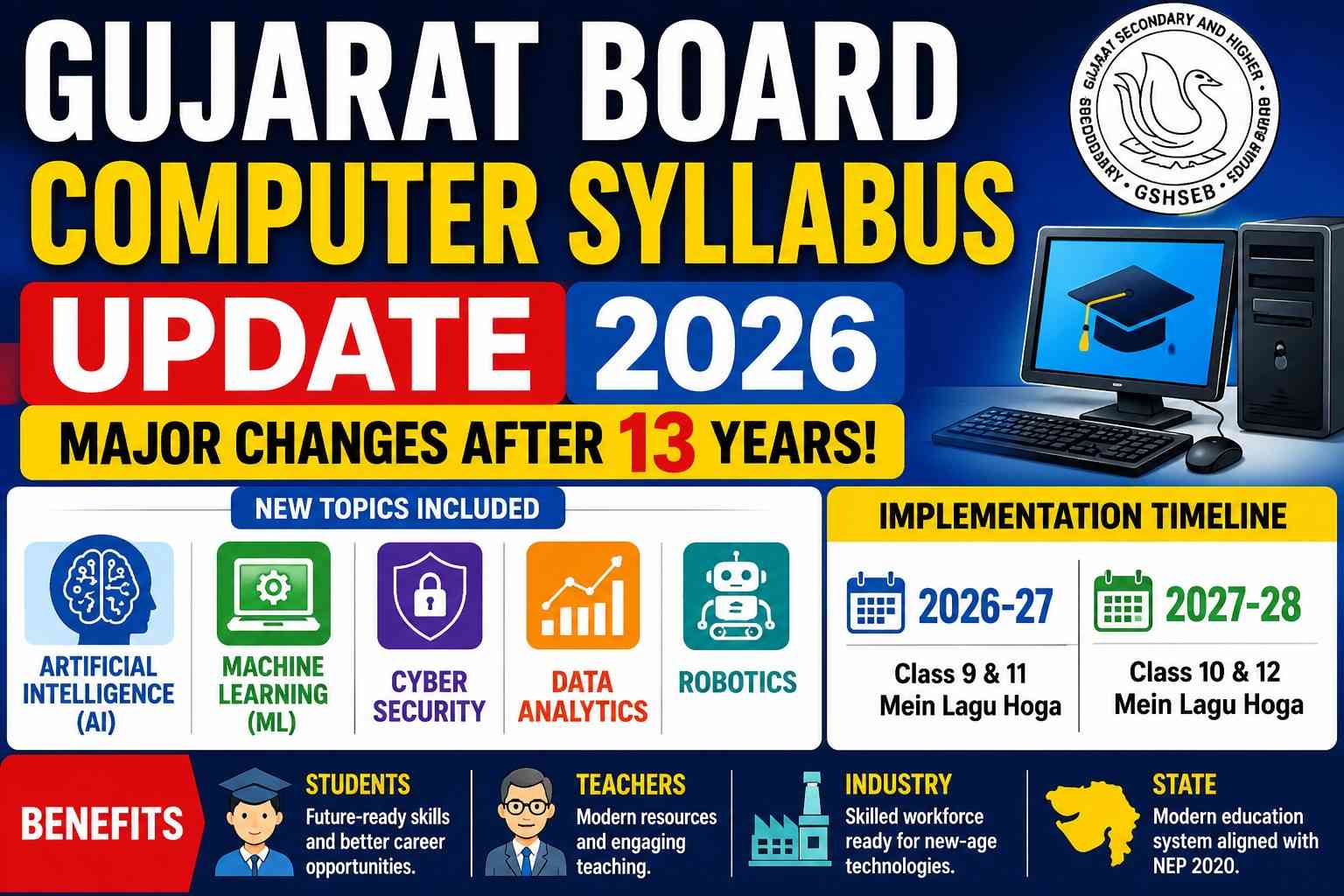
The Gujarat Board has revised its computer syllabus to include Artificial Intelligence (AI), Machine Learning (ML), Cybersecurity, Data Analytics, and Robotics. The new curriculum will be implemented in Classes 9 and 11 in the 2026–27 academic year, and in Classes 10 and 12 in 2027–28.
But the Gujarat Secondary and Higher Secondary Education Board (GSHSEB) has not yet made any official announcement; according to a report by The Times of India, the board has announced an upcoming revision. The old computer syllabus was revised in 2013–14, so it hasn't had a major update in 13 years. It only includes topics on outdated skills.
New textbooks are being prepared for the new syllabus. According to reports, topics related to today's industrial trends such as Artificial Intelligence (AI), Machine Learning (ML), Cybersecurity, Data Analytics, Cloud Computing, Internet of Things (IoT), and Robotics will be included.
New Topics: AI, ML, Cybersecurity, Data Analytics, Robotics
Artificial Intelligence (AI): This is a technology that can think like humans, understand them, and perform tasks, making it very effective at solving problems. Examples include voice assistants (Siri/Alexa), self-driving cars, and recommendation systems.
Machine Learning (ML): ML, a type of AI, teaches computers to learn from data without being explicitly programmed at every step. Example: If you show a computer many images of flowers, it will learn on its own which flower is which.
Cybersecurity: protecting your computer, network, and data from hackers and viruses. In other words, security in the digital world. For example, keeping the school's WiFi secure, creating strong passwords, and using antivirus software all fall under cybersecurity.
Data Analytics: This involves collecting, organizing, and analyzing data to extract useful information. For example, if a class has given marks in an exam, Data Analytics can reveal which topics were the most difficult or how the class's overall performance was. By observing these patterns, improvements can be made in the future.
Robotics: In robotics, robots (machines) are designed, built, and programmed to perform tasks that humans do. From small robots to automated machines in factories, everything falls under robotics. In robotics, you learn to operate a robot using sensors and programming.
The advantages and disadvantages of this are explained below.
Advantages of the new syllabus
For students: these new changes will equip students with future-ready skills. They will learn about AI/ML concepts and digital safety, which are in high demand in today's job market.
For teachers: Teachers will need to update their own training. They can make classes more engaging with new and interesting topics. Their role will shift more toward mentorship and guiding projects.
For the industry: the IT and tech sectors will gain the largest workforce. Students with AI/ML understanding will come straight from schools, reducing the gap between higher education and jobs.
For the State/State: The education system will become modern, aligning with the National Education Policy 2020. It will help stay ahead in future technology, which will attract tech companies to Gujarat and accelerate state development.
Disadvantages of the new syllabus
Infrastructure: schools currently lack up-to-date computer labs, high-speed internet, robotics kits, etc., especially in rural areas, so this will be a major challenge.
Teacher Training: teachers also need training to teach the new syllabus. They will have to understand and teach topics like AI and ML, which requires time and resources.
Curriculum Depth: Subjects like AI/ML and robotics are very broad. At the school level, we need to strike a balance in how deeply they're taught. The basics should be clear without skipping advanced topics.
Equity: Not all students have internet at home or devices, so they need extra support. Reducing the gap between rural and urban schools is a challenge.
Language Barrier: Technical terms are in English, which can be difficult for Gujarati/Hindi-medium students to understand. For this, study materials must also be made available in Hindi/Gujarati so that everyone can understand.
This article is based on media reports, publicly available information, and current updates related to the Gujarat Board computer syllabus. The Gujarat Secondary and Higher Secondary Education Board (GSHSEB) has not yet released an official final notification at the time of writing. Readers are advised to verify the latest and official details from the board’s website or authorized sources before making any decisions based on this information.